


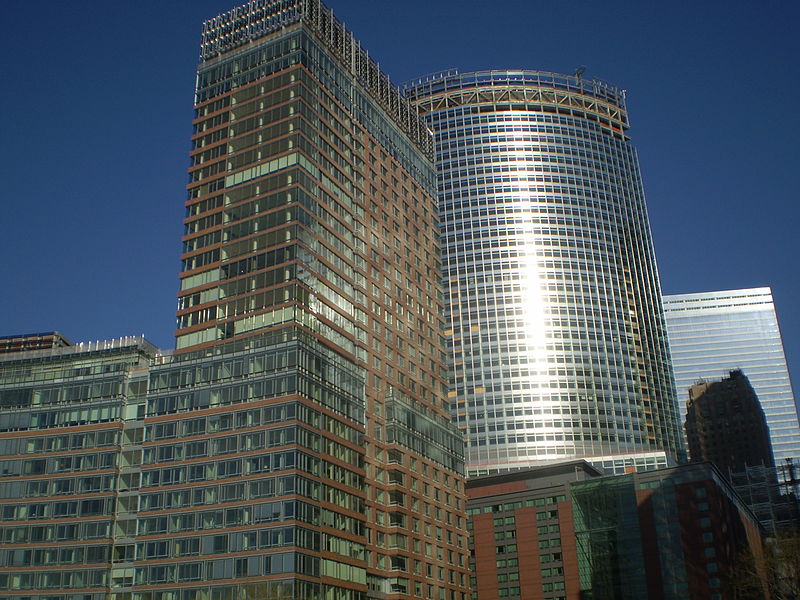

The Goldman Sachs Group, Inc. ( SAKS) is an American multinational investment bank and financial services company. It was founded in 1869 and is headquartered in the Battery Park City neighborhood of Manhattan in New York City, with offices in many financial centers worldwide. Goldman Sachs is one of the largest investment banks by revenue. It is ranked 32nd on the Fortune 500 and 19th on the Forbes Global 2000. It is considered a systemically important financial institution by the Financial Stability Board.
The company receives revenues from market making for many types of financial products (31% of 2025 revenues); net interest income (23% of 2025 revenues); investment management and wealth management (20% of 2025 revenues); investment banking (advisory for mergers and acquisitions and restructuring and securities underwriting, including initial public offerings) (16% of 2025 revenues); commissions and fees for clearing financial transactions (7% of 2025 revenues); and proprietary trading (3% of 2025 revenues).
Contents
History
Founding and establishment
In 1869, Goldman Sachs was founded by Marcus Goldman in New York City in a one-room basement office next to a coal chute. In 1882, Goldman's son-in-law Samuel Sachs joined the firm. In 1885, Goldman's son, Henry Goldman, and his son-in-law, Ludwig Dreyfuss, joined the firm, which then adopted the name Goldman Sachs & Co. The company pioneered the use of commercial paper for entrepreneurs and joined the New York Stock Exchange (NYSE) in 1896. In 1898, the firm's capital stood at $1.6 million. It opened offices in Boston and Chicago in 1900, San Francisco in 1918, and Philadelphia and St. Louis in 1920.
Goldman Sachs entered the initial public offering (IPO) market in 1906 when it underwrote the IPO of Sears. The deal was facilitated by Henry Goldman's personal friendship with Julius Rosenwald, an owner of Sears. Goldman Sachs underwrote the IPOs of General Cigar Company also in 1906, F. W. Woolworth Company in 1912, and Continental Can. The firm was an innovator at establishing the price–earnings ratio, instead of book value, as a method for valuing companies, and was therefore able to raise funds for retailers and companies with few hard assets.
In 1912, Henry S. Bowers became the first non-member of the founding family to become a partner of the firm and share in its profits. In 1917, under growing pressure from the other partners in the firm due to his pro-German stance, Henry Goldman resigned. The Sachs family gained full control of the firm until Waddill Catchings joined the company in 1918. By 1928, Catchings was the Goldman Sachs partner with the single largest stake in the firm. In 1919, the company acquired a major interest in Merck & Co. and in 1922, it acquired a major interest in General Foods. In December 1928, the firm launched the Goldman Sachs Trading Corp., a closed-end fund. The fund failed during the Wall Street Crash of 1929, amid accusations that Goldman Sachs had engaged in share price manipulation and insider trading.
1930–1979
In 1930, during the Great Depression, the firm ousted Catchings, and Sidney Weinberg assumed the role of senior partner. Weinberg shifted the firm's focus away from trading and toward investment banking. His actions helped to restore some of the firm's tarnished reputation. Under Weinberg's leadership, Goldman Sachs was the lead advisor on the $657 million IPO of Ford Motor Company in 1956, a major victory at the time, as well as the $350 million debenture offering by Sears Roebuck in 1958. Under Weinberg's leadership, the firm started an investment research division and a municipal bond department, and it became an early innovator in risk arbitrage.
In the 1950s, Gus Levy joined the firm as a securities trader, where two powers fought for supremacy, one from investment banking and one from securities trading. Levy was a pioneer in block trading and the firm established this trend under his guidance. Due to Weinberg's heavy influence, the firm formed an investment banking division in 1956 in an attempt to shift focus off Weinberg. In 1957, the firm's headquarters were relocated to 20 Broad Street, New York City.
In 1969, Levy took over Weinberg's role as senior partner and built the firm’s trading franchise once again. Levy is credited with the firm’s famous philosophy of being "long-term greedy," which implied that as long as money is made over the long term, short-term losses are bearable. At the same time, partners reinvested nearly all of their earnings in the firm. Weinberg remained a senior partner of the firm and died in July of that year.
Another financial crisis for the firm occurred in 1970, when the Penn Central Transportation Company went bankrupt with $87 million in commercial paper outstanding, most of it issued through Goldman Sachs. In 1969, Goldman Sachs allegedly continued to sell the debt to investors despite knowing that Penn Central's financials were deteriorating. In 1970, Goldman Sachs tried to force Penn Central to buy back debt unsold by Goldman Sachs, without extending the same offer to its customers. These actions of alleged impropriety led to an investigation by the United States Securities and Exchange Commission, which was settled. Customers that bought Penn Central debt sued Goldman Sachs; the potential liability could have bankrupted the firm. However, the firm settled the lawsuits, received insurance proceeds, and the value of the debt did recover. The bankruptcy of Penn Central resulted in credit ratings for every issuer of commercial paper today by several credit rating agencies.
1980–1999
In 1981, Goldman acquired Spears, Benzak Salomon & Farrell, an asset manager. It was sold to KeyCorp in 1995.
In November 1981, the firm acquired J. Aron & Company, a commodities trading firm involved in the coffee and gold markets. It was merged into the Fixed Income division, which was renamed as Fixed Income, Currencies, and Commodities. Lloyd Blankfein joined Goldman Sachs as a result of the merger.
In 1983, the firm moved into a newly constructed global headquarters at 85 Broad Street. It occupied that building until it moved to its current headquarters in 2009. In 1985, it underwrote the public offering of the real estate investment trust (REIT) that owned Rockefeller Center, then the largest REIT offering in history. During the dissolution of the Soviet Union, the firm was involved advising companies that were undergoing privatization.
In 1986, the firm formed Goldman Sachs Asset Management, which provides investment and advisory services, including private equity and alternative investments, across public and private markets for institutions, financial advisors, and individuals. Also in 1986, the firm underwrote the IPO of Microsoft, advised General Electric on its acquisition of RCA Corporation, and joined the London and Tokyo stock exchanges. During the 1980s, the firm became the first investment bank to distribute its investment research electronically and created the first public offering of original issue deep-discount bond. In 1988, Goldman Sachs helped the State Bank of India obtain a credit rating and issue US$200 million in the US commercial paper market.
Robert Rubin and Stephen Friedman became co-senior partners in 1990 and pledged to focus on globalization of the firm to strengthen the mergers and acquisitions and trading business lines. In 1990, the firm introduced paperless trading to the NYSE. Rubin left the firm in 1992 to work in the presidency of Bill Clinton. In 1994, the company launched the Goldman Sachs Commodity Index (GSCI) and opened its first office in China in Beijing. That same year, Jon Corzine became CEO, following the retirement of Friedman as senior partner.
After decades of debate among the partners, Goldman Sachs became a public company via an IPO in May 1999. Goldman Sachs sold 12.6% of the firm to the public, and after the IPO, 48.3% of the firm was held by 221 former partners, 21.2% of the firm was held by non-partner employees, and the remaining 17.9% was held by retired Goldman Sachs partners and two long-time investors, Sumitomo Bank and the investing arm of Kamehameha Schools. The shares were priced at $53 each at listing. After the IPO, Henry Paulson became chairman and chief executive officer, succeeding Jon Corzine.
2000–present
In September 2000, Goldman Sachs acquired Spear, Leeds, & Kellogg, one of the largest specialist firms on the New York Stock Exchange, for $6.3 billion.
In July 2003, Goldman Sachs acquired Ayco Company, a provider of financial plans and wealth management services for top-ranking company executives.
In May 2006, Henry Paulson left the firm to serve as United States Secretary of the Treasury, and Lloyd Blankfein was promoted to chairman and chief executive officer.
Before the subprime mortgage crisis, Goldman took out insurance on mortgage defaults from American International Group (AIG). Goldman Sachs was estimated to have $13 to $20 billion in counterparty exposure to AIG. As the value of the mortgages fell, Goldman Sachs issued billions of dollars in margin calls to AIG; however, the values of the underlying assets were subjective since they were not publicly traded. Goldman Sachs was accused of "being overly aggressive" with the margin calls and hastening the 2008 financial crisis.
In September 2008, facing a liquidity crisis as short-term credit markets froze due to the bankruptcy of Lehman Brothers, Goldman Sachs and Morgan Stanley, the last two major investment banks in the United States, both converted to bank holding companies to obtain access to the Federal Reserve's discount window for emergency loans. Also in September 2008, Berkshire Hathaway agreed to purchase $5 billion in Goldman Sachs preferred stock, and also received warrants to buy another $5 billion in Goldman Sachs common stock within five years. The company also raised $5 billion via a public offering of shares at $123 per share. Goldman Sachs also received a $10 billion preferred stock investment from the United States Department of the Treasury in October 2008, as part of the Troubled Asset Relief Program (TARP). In June 2009, Goldman Sachs repaid the U.S. Treasury's TARP investment, with 23% interest (in the form of $318 million in dividend payments and $1.418 billion in warrant redemptions). In March 2011, Goldman Sachs repurchased Berkshire Hathaway's preferred stock in Goldman Sachs.
In November 2009, Goldman Sachs opened its new headquarters at 200 West Street.
List of senior partners and CEOs
Marcus Goldman (1869–1893)
Samuel Sachs and Henry Goldman (1893–1914)
Henry Goldman (1914–1917)
Harry Sachs (1917–1921)
Waddill Catchings (1921–1930)
Sidney Weinberg (1930–1969)
Gus Levy (1969–1976)
John L. Weinberg and John C. Whitehead (1976–1984)
John L. Weinberg (1984–1990)
Robert Rubin and Stephen Friedman (1990–1992)
Stephen Friedman (1992–1994)
Jon Corzine (1994–1998)
Jon Corzine and Henry Paulson (1998–1999)
Henry Paulson (1999–2006)
Lloyd Blankfein (2006–2018)
David M. Solomon (2018–present)
Financials
Note: Financial data in billions of US dollars and employee data in thousands. The data is sourced from the company's SEC Form 10-K from 2000 to 2025.
Legal and regulatory issues
2003 global analyst research settlement
In 2003, Goldman Sachs resolved regulatory and civil claims regarding conflicts of interest between its equity research and investment banking businesses during the dot-com bubble. This included a $110 million payment as part of the multi-firm global analyst research settlement with the SEC and state regulators, alongside minor multi-bank class-action settlements concerning research coverage of specific entities including Exodus Communications and RSL Communications.
2008 financial crisis: Conflict of interest in Abacus mortgage-backed CDOs
Unlike many investors and investment banks, Goldman Sachs anticipated the subprime mortgage crisis. The company developed investments called synthetic CDOs, originally intended to protect Goldman Sachs from investment losses in the housing market. However, during the subprime mortgage crisis and the 2008 financial crisis, instead of warning its clients of the risks of investing in subprime debt, the company bet against its own clients, primarily insurance companies and pension funds, and profited, leading to allegations of a conflict of interest.
Goldman Sachs was accused of setting up and shorting the $800 million Hudson Mezzanine CDO, issued in 2006, with the goal of removing subprime securities from its books. While the prospectus of the CDO described the portfolio contents as assets sourced from the secondary market, critics noted the selection effectively acted as a short position against investments owned by the company. Following subsequent mortgage defaults, holders of the long position paid out approximately $310 million to the counterparties holding the short position.
Goldman Sachs claimed that it shorted simply to hedge its long positions and was not expecting the CDOs to fail. It also denied that its investors were unaware of Goldman Sachs's bets against the products.
In April 2010, the United States Securities and Exchange Commission (SEC) charged Goldman Sachs and one of its vice presidents, Fabrice Tourre, with securities fraud in the case of SEC v. Goldman Sachs. The 3-2 vote by the SEC to bring charges was along party lines, with the 2 Democrats and 1 independent voting in favor of bringing charges. The SEC alleged that Goldman Sachs had told buyers of a synthetic CDO that the underlying assets in the investment had been picked by an independent CDO manager, ACA Management. However, Paulson & Co., a hedge fund intending to bet against the investment, played a significant role in selecting the reference portfolio.
The specific synthetic CDO at the center of the SEC's 2010 suit was Abacus 2007-AC1. Unlike many of the Abacus securities, 2007-AC1 Goldman Sachs was not short; Goldman Sachs actually lost money on the deal. The short position was taken by John Paulson, who allegedly hired Goldman Sachs to issue the security. Paulson and his employees selected 90 BBB-rated mortgage bonds that they anticipated would decline in value to maximize the return on their short positions.
1MDB scandal
Between 2011 and 2013, Goldman Sachs underwrote approximately $6.5 billion in bond offerings for the Malaysian sovereign wealth fund, 1Malaysia Development Berhad (1MDB), which generated roughly $600 million in fees for the bank, 10 times the normal amount. Goldman Sachs was accused of ignoring major red flags and enabling a massive multi-billion-dollar theft by former Malaysian Prime Minister Najib Razak and Jho Low. In 2015, regulators launched investigations into the transactions, focusing on compliance failures under the Bank Secrecy Act and foreign bribery laws. In October 2020, Goldman Sachs settled the accusations by paying $2.9 billion in fines and penalties to authorities in the United States, Malaysia, Singapore, and the United Kingdom, while its Malaysian subsidiary pleaded guilty to criminal charges.