


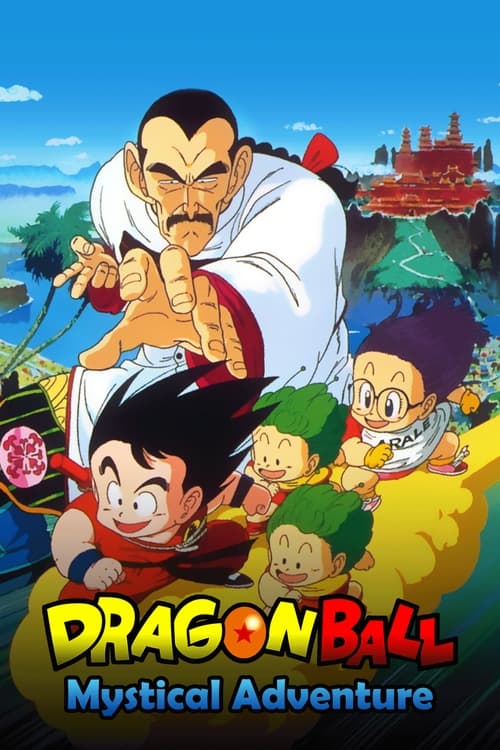






Dragon Ball: Mystical Adventure (Japanese: ドラゴンボール 魔訶不思議大冒険, Hepburn: Doragon Bōru Makafushigi Dai-Bōken) is a 1988 Japanese anime fantasy martial arts adventure film and the third alternate continuity Dragon Ball feature film. It was released in on July 9, 1988, at the "Toei Manga Matsuri" film festival as part of a quadruple feature along with Bikkuriman 2: The Secret of Muen Zone, Tatakae!! Ramenman, and Kamen Rider Black: Terrifying! The Phantom House of Devil Pass.
Unlike the previous two Dragon Ball films, Mystical Adventure does not introduce any original characters, but instead adapts characters from the Red Ribbon Army and 22nd World Martial Arts Tournament story arcs from the manga into the film's original storyline. It was preceded by Dragon Ball: Sleeping Princess in Devil's Castle and followed by Dragon Ball Z: Dead Zone, the first film entry in the Dragon Ball Z follow-up to the original Dragon Ball series. Another entry in the Dragon Ball film series, Dragon Ball: The Path to Power, released in 1996.
Contents
Plot
Mystical Adventure is another retelling of the Dragon Ball story. This time, young Goku and young Krillin are training with Master Roshi for a World Martial Arts Tournament to be held in the country of Mifan. The Emperor of Mifan, Chiaotzu, is trying to find his lost "Ran Ran." "Minister" Master Shen has Emperor Pilaf work on a Dragon Radar, takes it from him, and is using it to locate the Dragon Balls. Shen and Mercenary Tao claim that they will use the wish from Shenron to locate Ran Ran, but are actually planning, with Tien's help, to kill Chiaotzu and take over the country. General Blue announces that Ran Ran is being held in Shen's room, and is killed by Tao for it. Bora and Upa have located the final Dragon Ball and they take it to Mifan to use it to demand that Mifan's soldiers be forced to leave the land near Korin Tower.
Bora is tricked into entering the Tournament (the winner of the Tournament will be granted one wish by Chiaotzu), and is then killed by Tao. Bulma, Oolong, Launch and Puar are looking for the other six Dragon Balls, so Bulma can wish for a boyfriend. However, when the Dragon Balls are located, they are accidentally dropped to the bottom of the moat surrounding Chiaotzu castle. Tien realizes that he likes Chiaotzu too much, and does not kill his friend; instead, he blows away Shen. Then he gives Chiaotzu back Ran Ran (actually a porcelain doll, not a real girl) telling him he had hidden her because of Shen and Tao. The story of Blue and Goku entering Penguin village is included, but this time it is Tao and Goku that meet Arale and Goku kills Tao with Arale's help. Goku throws the final ball into the moat, and summons Shenron, whom Upa asks to resurrect Bora.
Music
OP (Opening Theme):
"Makafushigi Adventure!"
Lyrics by Yuriko Mori
Music by Takeshi Ike
Arranged by Kōhei Tanaka
Performed by Hiroki Takahashi
ED (Ending Theme):
Doragon Bōru Densetsu (ドラゴンボール伝説, "Dragon Ball Legend")
Lyrics by Onikado Izumi
Music by Takeshi Ike
Arranged by Seiichi Kyōda
Performed by Hiroki Takahashi
Releases
Box office
At the Japanese box office, the film sold 1.9 million tickets and earned a net distribution rental income of ¥650 million.
English-language versions
Harmony Gold USA broadcast their dub of this film and Curse of the Blood Rubies as a double feature on WPSG Philly 57 in Philadelphia, Pennsylvania and on other channels and cable systems in a select few test markets. It was also likely to have been released on home video in the early 90s. It was not widely noticed and went under the radar. Their dub changed the names of some of the characters and had parts of it censored, and the opening and ending sequence changed with; instead of the first Japanese sequence they used the second Japanese sequence, with the Japanese katakana removed from the Dragon Balls, the Japanese credits removed and replaced with the Harmony Gold credits, and they changed some of the dialog from the Japanese intro. The ending was changed from the Japanese ending to show a still picture of Goku flying away from Shenron (known as Dragon God in the Harmony Gold dub) taken from the intro, and using the intro theme song instead of the Japanese ending theme with the Harmony Gold credits. The script was more faithful to the Japanese script and all the background music was kept the same, unlike the Funimation and AB Groupe dubs.
There was also another English dub released exclusively to Video CD by Speedy Video. This English version, produced and released exclusively in Malaysia, features an unknown cast and original music.
Funimation acquired the rights to the film in 2000 and released it with a new dub to VHS and bilingual DVD that year.
Madman Entertainment released the film on DVD in Australia and New Zealand on March 17, 2004 with the 2000 English dub and optional Japanese audio. However, the introduction, which began the narration of the Dragon Balls, a cameo sequence of Pilaf and his gang presenting a global dragon radar to Master Shen, and a different opening sequence to the film featuring Goku and Krillin in training were cut. Instead, the opening sequence and scenes aforementioned were replaced with the TV opening sequence. Another sequence cut was the closing credits featuring a summoned Shenron who fulfilled Upa's wish to bring Bora back to life. The scene was replaced with the TV closing sequence.
Subsequent versions of the FUNimation dub had restored its introduction and its opening/ending sequence. Unlike the Japanese version however, the opening sequence had many scenes in freeze-frame, as a way to block out the original Japanese credits that were in the sequence. The closing credits was restored with English credits censoring half the screen, also as a way to block out the original Japanese credits scrolling from the right.


