

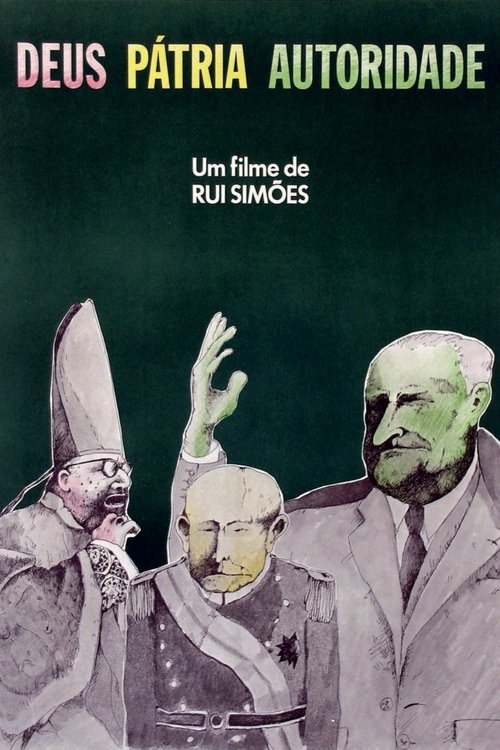
Deus, Pátria, Autoridade (God, Homeland, Authority) is a 1975 Portuguese film by the filmmaker Rui Simões. It is a feature-length documentary film made up of historic newsreels made by the Estado Novo dictatorship, especially under António de Oliveira Salazar.
Contents
Summary
Script: Rui Simões
Director: Rui Simões
Producers: Instituto Português de Cinema and RTP
Format: 35 mm black and white
Genre: Documentary (historical)
Duration: 103 min
Distribution: Instituto Português de Cinema
Premiere: Lisbon, at the Universal Cinema, 21 February 1976
Synopsis
The film's title quotes from well-known lines from a 1936 speech by Salazar in which he described three cornerstone dogmas of his government with the words: "We do not discuss God and Virtue. We do not discuss the Homeland and its history. We do not discuss Authority and its prestige." ("Não discutimos Deus e a virtude. Não discutimos a Pátria e a sua história. Não discutimos a Autoridade e o seu prestígio.") The film is made principally out of archival material and footage from newsreels. The narrative is voiced over the montage, deconstructing the fascist ideology illuminated in Salazar's speech and guiding the viewer through the film.
The film explains the development and ideology of the regime, from a social perspective of class struggle. Major themes are the history and functional principles of Portuguese society from the end of the Monarchy in 1910, the ideology of the Salazar dictatorship, the support of the Roman Catholic Church, the mechanisms of oppression, and the Portuguese Colonial War, up to the Carnation Revolution on 25 April 1974.
Production and reception
The Portuguese filmmaker Rui Simões directed, wrote the screenplay, and produced the film for the film collective Cooperativa Virver. The work was financed mainly by the Portuguese state Instituto Português de Cinema (today the Instituto do Cinema e do Audiovisual, ICA), with the participation of the public television broadcaster Rádio e Televisão de Portugal (RTP).
The film premiered at the Universal Cinema in Lisbon, on 21 February 1976, and enjoyed a successful run with 22,188 tickets sold. However, the film was frequently shown outside of regular cinemas, on a wide variety of occasions, probably reaching several hundred thousand people.
Costa do Castelo Filmes released the film on VHS videocassette and on DVD in 2006; later, Real Ficção re-released the film on DVD.
Credits
Script: Rui Simões
Director: Rui Simões
Director's Assistants: Manuela Serra and Francisco Henriques
Producers: Instituto Português de Cinema and RTP
Collaborators: Artur da Costa, Alice Pinto, Noémia Delgado, José Pedro Andrade dos Santos, J.M. Diogo, Raymond Fromont, Matilde Ferreira
Animation: Geneviève Antoine and Mário Jorge
Photography: Acácio de Almeida, Gérard Collet, José Reynès, Francisco Henriques
Sound directors: Luís Martins e Rui Simões
Music: Carmina Burana de Carl Orff
Sound effects and mixing: Rui Simões
Montage: Dominique Rolin
Assistant on the Montage: Manuela Serra
Recording: 1975
Film studio: Ulyssea Filme
Sound studio: Nacional Filmes
Archival materials: Ulyssea Filme, RTP, Emissora Nacional
Format: 35 mm black and white
Genre: Documentary (historical)
Duration: 103 min
Distribution: Instituto Português de Cinema
Festivals and exhibitions
28ª Mostra Brasileira de Cinema (2004)
31ª Mostra Internacional de Cinema in São Paulo
VI Jornadas Independentistas Galegas (2007)