
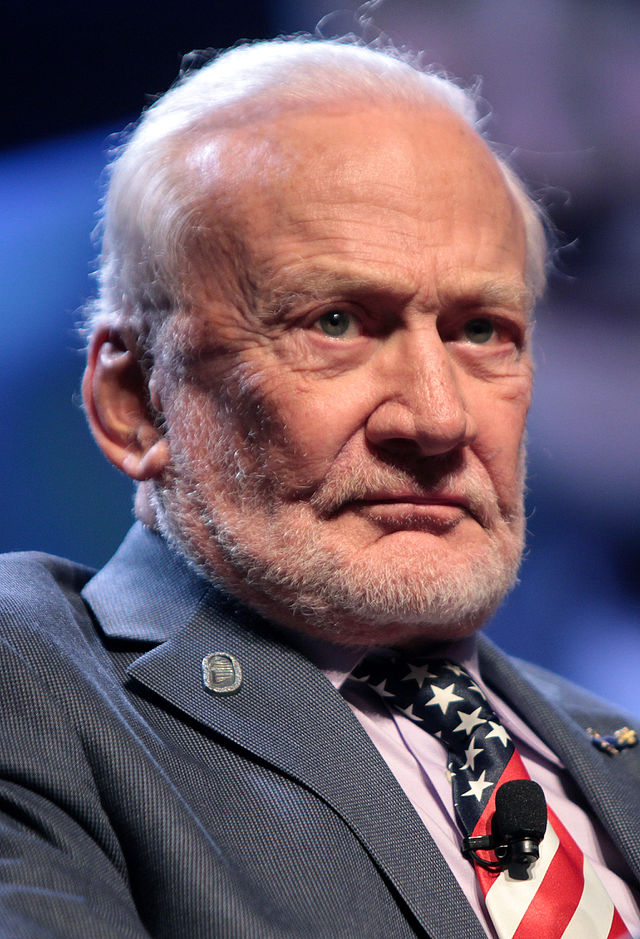

Buzz Aldrin ( AWL-drin; born Edwin Eugene Aldrin Jr.; January 20, 1930) is an American former astronaut, aeronautical engineer, and fighter pilot. He was the second person to walk on the Moon after mission commander Neil Armstrong. He made three spacewalks as pilot of NASA’s 1966 Gemini 12 mission, and was the Lunar Module Eagle pilot on the 1969 Apollo 11 mission. Following the deaths of Armstrong in 2012 and pilot Michael Collins in 2021, Aldrin is the last surviving Apollo 11 crew member, and the oldest living astronaut.
Born in Glen Ridge, New Jersey, Aldrin graduated third in the class of 1951 from the United States Military Academy at West Point with a degree in mechanical engineering. He was commissioned into the United States Air Force and served as a jet fighter pilot during the Korean War. He flew 66 combat missions and shot down two MiG-15 fighter jets.
After earning a Doctor of Science degree in astronautics from the Massachusetts Institute of Technology (MIT), Aldrin was selected as a member of NASA's Astronaut Group 3, making him the first astronaut with a doctoral degree. His doctoral thesis, Line-of-Sight Guidance Techniques for Manned Orbital Rendezvous, earned him the nickname "Dr. Rendezvous" from fellow astronauts. His first space flight was in 1966 on Gemini 12, during which he spent over five hours on extravehicular activity. Three years later, Aldrin set foot on the Moon at 03:15:16 on July 21, 1969 (UTC), nineteen minutes after Armstrong first touched the surface, while command module pilot Michael Collins remained in lunar orbit. A Presbyterian elder, Aldrin became the first person to hold a religious ceremony on the Moon, when he privately took communion, which was the first food and liquid to be consumed there.
After leaving NASA in 1971, Aldrin became Commandant of the U.S. Air Force Test Pilot School. He retired from the Air Force in 1972 after 21 years of service. His autobiographies Return to Earth (1973) and Magnificent Desolation (2009) recount his struggles with clinical depression and alcoholism in the years after leaving NASA. Aldrin continues to advocate for space exploration, particularly a human mission to Mars. He developed the Aldrin cycler, a special spacecraft trajectory that makes travel to Mars more efficient in terms of time and propellant. He has been accorded numerous honors, including the Presidential Medal of Freedom in 1969.
Contents
Early life and education
Aldrin was born Edwin Eugene Aldrin Jr. on January 20, 1930, at Mountainside Hospital in Glen Ridge, New Jersey. His parents, Edwin Eugene Aldrin Sr. and Marion Aldrin (née Moon), lived in neighboring Montclair. His father was an Army aviator during World War I and the assistant commandant of the Army's test pilot school at McCook Field, Ohio, from 1919 to 1922, but left the Army in 1928 and became an executive at Standard Oil. Aldrin had two sisters: Madeleine, who was four years older, and Fay Ann, who was a year and a half older. His nickname, which became his legal first name in 1988, arose as a result of Fay's mispronouncing "brother" as "buzzer", which was then shortened to "Buzz". He was a Boy Scout, achieving the rank of Tenderfoot Scout.
Aldrin did well in school, maintaining an A average. He played football and was the starting center for Montclair High School's undefeated 1946 state champion team. His father wanted him to go to the United States Naval Academy in Annapolis, Maryland, and enrolled him at nearby Severn School, a preparatory school for Annapolis, and even secured him a Naval Academy appointment from Albert W. Hawkes, one of the United States senators from New Jersey. Aldrin attended Severn School in 1946, but had other ideas about his future career. He suffered from seasickness and considered ships a distraction from flying airplanes. He faced down his father and told him to ask Hawkes to change the nomination to the United States Military Academy at West Point, New York.
Aldrin entered West Point in 1947. He did well academically, finishing first in his class his plebe (first) year. Aldrin was also an excellent athlete, competing in pole vault for the academy track and field team. In 1950, he traveled with a group of West Point cadets to Japan and the Philippines to study the military government policies of Douglas MacArthur. During the trip, the Korean War broke out. On June 5, 1951, Aldrin graduated third in the class of 1951 with a Bachelor of Science degree in mechanical engineering.
U.S. Air Force officer (1951–1972)
Early career
Among the top of his class, Aldrin had his choice of assignments. He chose the United States Air Force, which had become a separate service in 1947 while Aldrin was still at West Point and did not yet have its own academy. He was commissioned as a second lieutenant and underwent basic flight training in T-6 Texans at Bartow Air Base in Florida. His classmates included Sam Johnson, who later became a prisoner of war in Vietnam; the two became friends. At one point, Aldrin attempted a double Immelmann turn in a T-28 Trojan and suffered a grayout. He recovered in time to pull out at about 2,000 feet (610 m), averting what would have been a fatal crash.
When Aldrin was deciding what sort of aircraft he should fly, his father advised him to choose bombers, because command of a bomber crew gave an opportunity to learn and hone leadership skills, which could open up better prospects for career advancement. Aldrin chose instead to fly fighters. He moved to Nellis Air Force Base in Las Vegas, where he learned to fly the F-80 Shooting Star and the F-86 Sabre. Like most jet fighter pilots of the era, he preferred the latter.
Korean war (1952–1953)
In December 1952, Aldrin was assigned to the 16th Fighter-Interceptor Squadron, which was part of the 51st Fighter-Interceptor Wing. At the time it was based at Suwon Air Base, about 20 miles (32 km) south of Seoul, and was engaged in combat operations as part of the Korean War. During an acclimatization flight, his main fuel system froze at 100 percent power, which would have soon used up all his fuel. He was able to override the setting manually, but this required holding a button down, which in turn made it impossible to also use his radio. He barely managed to make it back under enforced radio silence. He flew 66 combat missions in F-86 Sabres in Korea and shot down two MiG-15 aircraft.
The first MiG-15 he shot down was on May 14, 1953. Aldrin was flying about 5 miles (8.0 km) south of the Yalu River, when he saw two MiG-15 fighters below him. Aldrin opened fire on one of the MiGs, whose pilot may never have seen him coming. The June 8, 1953, issue of Life magazine featured gun camera footage taken by Aldrin of the pilot ejecting from his damaged aircraft.
Aldrin's second aerial victory came on June 4, 1953, when he accompanied aircraft from the 39th Fighter-Interceptor Squadron in an attack on an airbase in North Korea. Their newer aircraft were faster than his and he had trouble keeping up. He then spotted a MiG approaching from above. This time, Aldrin and his opponent spotted each other at about the same time. They went through a series of scissor maneuvers, attempting to get behind the other. Aldrin was first to do so, but his gun sight jammed. He then manually sighted his gun and fired. He then had to pull out, as the two aircraft had gotten too low for the dogfight to continue. Aldrin saw the MiG's canopy open and the pilot eject, although Aldrin was uncertain whether there was sufficient time for a parachute to open. For his service in Korea, he was awarded two Distinguished Flying Crosses and three Air Medals.
Post-war
Aldrin's year-long tour ended in December 1953, by which time the fighting in Korea had ended. Aldrin was assigned as an aerial gunnery instructor at Nellis. In December 1954 he became an aide-de-camp to Brigadier General Don Z. Zimmerman, the Dean of Faculty at the nascent United States Air Force Academy, which opened in 1955. That same year, he graduated from the Squadron Officer School at Maxwell Air Force Base in Alabama. From 1956 to 1959 he flew F-100 Super Sabres equipped with nuclear weapons as a flight commander in the 22nd Fighter Squadron, 36th Fighter Wing, stationed at Bitburg Air Base in West Germany. Among his squadron colleagues was Ed White, who had been a year behind him at West Point. After White left West Germany to study for a master's degree at the University of Michigan in aeronautical engineering, he wrote to Aldrin encouraging him to do the same.
Through the Air Force Institute of Technology, Aldrin enrolled as a graduate student at the Massachusetts Institute of Technology in 1959 intending to earn a master's degree. Richard Battin was the professor for his astrodynamics class. Two other USAF officers who later became astronauts, David Scott and Edgar Mitchell, took the course around this time. Another USAF officer, Charles Duke, also took the course and wrote his 1964 master's degree at MIT under the supervision of Laurence R. Young.
Aldrin enjoyed the classwork and soon decided to pursue a doctorate instead. In January 1963, he earned a Sc.D. degree in astronautics. His doctoral thesis was Line-of-Sight Guidance Techniques for Manned Orbital Rendezvous, the dedication of which read: "In the hopes that this work may in some way contribute to their exploration of space, this is dedicated to the crew members of this country's present and future manned space programs. If only I could join them in their exciting endeavors!" Aldrin chose his doctoral thesis in the hope that it would help him be selected as an astronaut, although it meant foregoing test pilot training, which was a prerequisite at the time.
After completing his doctorate, Aldrin was assigned to the Gemini Target Office of the Air Force Space Systems Division in Los Angeles, working with the Lockheed Aircraft Corporation on enhancing the maneuver capabilities of the Agena target vehicle which was to be used by NASA's Project Gemini. He was then posted to the Space Systems Division's field office at NASA's Manned Spacecraft Center in Houston, where he was involved in integrating Department of Defense experiments into Project Gemini flights.
NASA astronaut (1963–1971)
Aldrin initially applied to join the astronaut corps when NASA's Astronaut Group 2 was selected in 1962. His application was rejected on the grounds that he was not a test pilot. Aldrin was aware of the requirement and asked for a waiver but the request was turned down. On May 15, 1963, NASA announced another round of selections, this time with the requirement that applicants had either test pilot experience or 1,000 hours of flying time in jet aircraft. Aldrin had over 2,500 hours of flying time, of which 2,200 was in jets. His selection as one of fourteen members of NASA's Astronaut Group 3 was announced on October 18, 1963. This made him the first astronaut with a doctoral degree which, combined with his expertise in orbital mechanics, earned him the nickname "Dr. Rendezvous" from his fellow astronauts. Although Aldrin was both the most educated and the rendezvous expert in the astronaut corps, he was aware that the nickname was not always intended as a compliment. Upon completion of initial training, each new astronaut was assigned a field of expertise; in Aldrin's case, it was mission planning, trajectory analysis, and flight plans.
Gemini program
Jim Lovell and Aldrin were selected as the backup crew of Gemini 10, commander and pilot respectively. Backup crews usually became the prime crew of the third following mission, but the last scheduled mission in the program was Gemini 12. The February 28, 1966, deaths of the Gemini 9 prime crew, Elliot See and Charles Bassett, in an air crash, led to Lovell and Aldrin being moved up one mission to backup for Gemini 9, which put them in position as prime crew for Gemini 12. They were designated its prime crew on June 17, 1966, with Gordon Cooper and Gene Cernan as their backups.
Initially, Gemini 12's mission objectives were uncertain. As the last scheduled mission, it was primarily intended to complete tasks that had not been successfully or fully carried out on earlier missions. While NASA had successfully performed rendezvous during Project Gemini, the gravity-gradient stabilization test on Gemini 11 was unsuccessful. NASA also had concerns about extravehicular activity (EVA). Cernan on Gemini 9 and Richard Gordon on Gemini 11 had suffered from fatigue carrying out tasks during EVA, but Michael Collins had a successful EVA on Gemini 10, which suggested that the order in which he had performed his tasks was an important factor.
It therefore fell to Aldrin to complete Gemini's EVA goals. NASA formed a committee to give him a better chance of success. It dropped the test of the Air Force's astronaut maneuvering unit (AMU) that had given Gordon trouble on Gemini 11 so Aldrin could focus on EVA. NASA revamped the training program, opting for underwater training over parabolic flight. Aircraft flying a parabolic trajectory had given astronauts an experience of weightlessness in training, but there was a delay between each parabola which gave astronauts several minutes of rest. It also encouraged performing tasks quickly, whereas in space they had to be done slowly and deliberately. Training in a viscous, buoyant fluid gave a better simulation. NASA also placed additional handholds on the capsule, which were increased from nine on Gemini 9 to 44 on Gemini 12, and created workstations where he could anchor his feet.
Gemini 12's main objectives were to rendezvous with a target vehicle, and fly the spacecraft and target vehicle together using gravity-gradient stabilization, perform docked maneuvers using the Agena propulsion system to change orbit, conduct a tethered stationkeeping exercise and three EVAs, and demonstrate an automatic reentry. Gemini 12 also carried 14 scientific, medical, and technological experiments. It was not a trailblazing mission; rendezvous from above had already been successfully performed by Gemini 9, and the tethered vehicle exercise by Gemini 11. Even gravity-gradient stabilization had been attempted by Gemini 11, albeit unsuccessfully.
Apollo program
Lovell and Aldrin were assigned to an Apollo crew with Neil Armstrong as commander, Lovell as command module pilot (CMP), and Aldrin as lunar module pilot (LMP). Their assignment as the backup crew of Apollo 9 was announced on November 20, 1967. Due to design and manufacturing delays in the Apollo Lunar Module (LM), Apollo 8 and Apollo 9 swapped prime and backup crews, and Armstrong's crew became the backup for Apollo 8. Under the normal crew rotation scheme, Armstrong was expected to command Apollo 11.
Michael Collins, the CMP on the Apollo 8 prime crew, required surgery to remove a bone spur on his spine. Lovell took his place on the Apollo 8 crew. When Collins recovered he joined Armstrong's crew as CMP. In the meantime, Fred Haise filled in as backup LMP, and Aldrin as backup CMP for Apollo 8. While the CMP usually occupied the center couch on launch, Aldrin occupied it rather than Collins, as he had already been trained to operate its console on liftoff before Collins arrived.
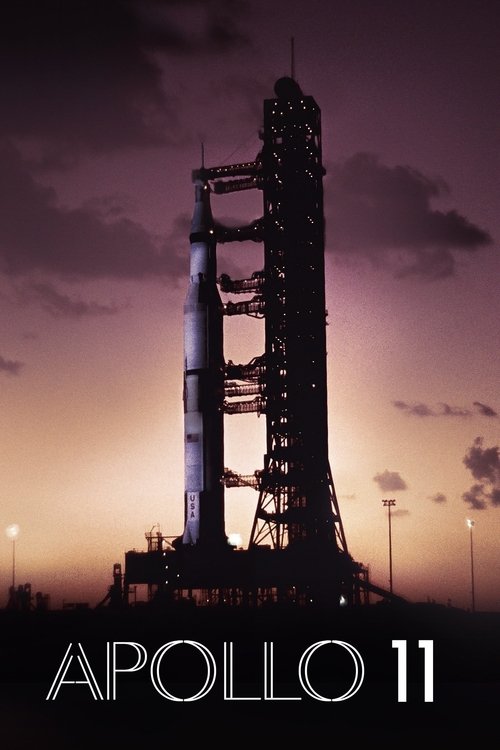
Apollo 11 was the second American space mission made up entirely of astronauts who had already flown in space, the first being Apollo 10. The next would not be flown until STS-26 in 1988. Deke Slayton, who was responsible for astronaut flight assignments, gave Armstrong the option to replace Aldrin with Lovell, since some thought Aldrin was difficult to work with. Armstrong thought it over for a day before declining. He had no issues working with Aldrin, and thought Lovell deserved his own command.
Early versions of the EVA checklist had the Lunar Module pilot as the first to step onto the lunar surface. However, when Aldrin learned that this might be amended, he lobbied within NASA for the original procedure to be followed. Multiple factors contributed to the final decision, including the physical positioning of the astronauts within the compact lunar lander, which made it easier for Armstrong to be the first to exit the spacecraft. Furthermore, there was little support for Aldrin's views among senior astronauts who would command later Apollo missions. Collins has commented that he thought Aldrin "resents not being first on the Moon more than he appreciates being second".
Aldrin and Armstrong did not have time to perform much geological training. The first lunar landing focused more on landing on the Moon and making it safely back to Earth than the scientific aspects of the mission. The duo was briefed by NASA and USGS geologists. They made one geological field trip to West Texas. The press followed them, and a helicopter made it hard for Aldrin and Armstrong to hear their instructor.
Later life (1971–present)
Aerospace Research Pilot School
Aldrin hoped to become Commandant of Cadets at the United States Air Force Academy, but the job went to his West Point classmate Hoyt S. Vandenberg Jr. Aldrin was made Commandant of the USAF Aerospace Research Pilot School at Edwards Air Force Base, California. Aldrin had neither managerial nor test pilot experience, but a third of the training curriculum was devoted to astronaut training and students flew a modified F-104 Starfighter to the edge of space. Fellow Group 3 astronaut and moonwalker Alan Bean considered him well qualified for the job.
Aldrin did not get along well with his superior, Brigadier General Robert M. White, who had earned his USAF astronaut wings flying the X-15. Aldrin's celebrity status led people to defer to him more than the higher-ranking general. There were two crashes at Edwards, of an A-7 Corsair II and a T-33. No people died, but the aircraft were destroyed and the accidents were attributed to insufficient supervision, which placed the blame on Aldrin. What he had hoped would be an enjoyable job became a highly stressful one.
Aldrin went to see the base surgeon. In addition to signs of depression, he experienced neck and shoulder pains, and hoped that the latter might explain the former. He was hospitalized for depression at Wilford Hall Medical Center for four weeks. His mother had committed suicide in May 1968, and he was plagued with guilt that his fame after Gemini 12 had contributed. His mother's father had also committed suicide, and he believed he inherited depression from them. At the time there was great stigma related to mental illness and he was aware that it could not only be career-ending, but could result in his being ostracized socially.
In February 1972, General George S. Brown visited Edwards and informed Aldrin that the USAF Aerospace Research Pilot School was being renamed the USAF Test Pilot School and the astronaut training was being dropped. With the Apollo program winding down, and Air Force budgets being cut, the Air Force's interest in space diminished. Aldrin elected to retire as a colonel on March 1, 1972, after 21 years of service. His father and General Jimmy Doolittle, a close friend of his father, attended the formal retirement ceremony.
Post-retirement
Aldrin's father died on December 28, 1974, from complications following a heart attack. Aldrin's autobiographies, Return to Earth (1973) and Magnificent Desolation (2009), recounted his struggles with clinical depression and alcoholism in the years after leaving NASA. Encouraged by a therapist to take a regular job, Aldrin worked selling used cars, at which he had no talent. Periods of hospitalization and sobriety alternated with bouts of heavy drinking. Eventually he was arrested for disorderly conduct. Finally, in October 1978, he quit drinking for good. Aldrin attempted to help others with drinking problems, including actor William Holden. Holden's girlfriend Stefanie Powers had portrayed Marianne, a woman with whom Aldrin had an affair, in the 1976 TV movie version of Return to Earth. Aldrin was saddened by Holden's alcohol-related death in 1981.
On September 9, 2002, Aldrin was lured to a Beverly Hills hotel on the pretext of being interviewed for a Japanese children's television show on the subject of space. When he arrived, Moon landing conspiracy theorist Bart Sibrel accosted him with a film crew and demanded he swear on a Bible that the Moon landings were not faked. After a brief confrontation, during which Sibrel followed Aldrin despite being told to leave him alone and called him "a coward, a liar, and a thief," the 72-year-old Aldrin punched Sibrel in the jaw, an act caught on camera by Sibrel's film crew. Aldrin said he had acted to defend himself and his stepdaughter. Witnesses said Sibrel had aggressively poked Aldrin with a Bible. Additional mitigating factors were that Sibrel sustained no visible injury and did not seek medical attention, and that Aldrin had no criminal record. The police declined to press charges against Aldrin, and the deputy district attorney of the Beverly Hills office declared that Sibrel had provoked him.
In 2005, while being interviewed for a Science Channel documentary titled First on the Moon: The Untold Story, Aldrin told an interviewer the Apollo 11 crew had seen an unidentified flying object (UFO). The documentary makers omitted the crew's conclusion that they probably saw one of the four detached spacecraft adapter panels from the upper stage of the Saturn V rocket. The panels had been jettisoned before the separation maneuver so they closely followed the spacecraft until the first mid-course correction. When Aldrin appeared on The Howard Stern Show on August 15, 2007, Stern asked him about the supposed UFO sighting. Aldrin confirmed that there was no such sighting of anything deemed extraterrestrial and said they were, and are, "99.9 percent" sure the object was the detached panel. According to Aldrin his words had been taken out of context. He made a request to the Science Channel to make a correction, but was refused.
Awards and honors
Aldrin was awarded the Air Force Distinguished Service Medal (DSM) in 1969 for his role as Lunar Module pilot on Apollo 11. He was awarded an oak leaf cluster in 1972 in lieu of a second DSM for his role in both the Korean War and in the space program, and the Legion of Merit for his role in the Gemini and Apollo programs. During a 1966 ceremony marking the end of the Gemini program, Aldrin was awarded the NASA Exceptional Service Medal by President Johnson at LBJ Ranch. He was awarded the NASA Distinguished Service Medal in 1970 for the Apollo 11 mission. Aldrin was one of ten Gemini astronauts inducted into the International Space Hall of Fame in 1982. He was also inducted into the U.S. Astronaut Hall of Fame in 1993, the National Aviation Hall of Fame in 2000, and the New Jersey Hall of Fame in 2008.
The Toy Story character Buzz Lightyear was named in honor of Buzz Aldrin.
In 1999, while celebrating the 30th anniversary of the lunar landing, Vice President Al Gore, who was also the vice-chancellor of the Smithsonian Institution's Board of Regents, presented the Apollo 11 crew with the Smithsonian Institution's Langley Gold Medal for aviation. After the ceremony, the crew went to the White House and presented President Bill Clinton with an encased Moon rock. The Apollo 11 crew was awarded the New Frontier Congressional Gold Medal in the Capitol Rotunda in 2011. During the ceremony, NASA administrator Charles Bolden said, "Those of us who have had the privilege to fly in space followed the trail they forged."
The Apollo 11 crew were awarded the Collier Trophy in 1969. The National Aeronautic Association president awarded a duplicate trophy to Collins and Aldrin at a ceremony. The crew was awarded the 1969 General Thomas D. White USAF Space Trophy. The National Space Club named the crew the winners of the 1970 Dr. Robert H. Goddard Memorial Trophy, awarded annually for the greatest achievement in spaceflight. They received the international Harmon Trophy for aviators in 1970, conferred to them by Vice President Spiro Agnew in 1971. Agnew also presented them the Hubbard Medal of the National Geographic Society in 1970. He told them, "You've won a place alongside Christopher Columbus in American history". In 1970, the Apollo 11 team were co-winners of the Iven C. Kincheloe award from the Society of Experimental Test Pilots along with Darryl Greenamyer who broke the world speed record for piston engine airplanes. For contributions to the television industry, they were honored with round plaques on the Hollywood Walk of Fame.
Personal life
Marriages and children
Aldrin has been married four times. His first marriage was on December 29, 1954, to Joan Archer (1930–2015), a Rutgers University and Columbia University alumna with a master's degree. They filed for divorce in 1974. They had three children, James, Janice and Andrew. As of 2025, he had one grandson, Jeffrey Schuss, born to his daughter Janice, and three great-grandsons and one great-granddaughter.
His second wife was Beverly Van Zile, whom he married on December 31, 1975, and divorced in 1978.
His third wife was Lois Driggs Cannon (1929–2018), whom he married on February 14, 1988. Their divorce was finalized in December 2012. The settlement included 50 percent of their $475,000 bank account and $9,500 a month plus 30 percent of his annual income, estimated at more than $600,000.
On January 20, 2023, his 93rd birthday, Aldrin married for the fourth time, to his 63-year-old companion, Anca Faur. She died peacefully on October 28, 2025, at the age of 66. Aldrin described Faur as "the love of [his] life."
Legal disputes
In 2018, Aldrin was involved in a legal dispute with his children Andrew and Janice and former business manager Christina Korp over their claims that he was mentally impaired through dementia and Alzheimer's disease. His children alleged that he made new friends who were alienating him from the family and encouraging him to spend his savings at a high rate. They sought to be named legal guardians so they could control his finances. In June, Aldrin filed a lawsuit against Andrew, Janice, Korp, and businesses and foundations run by the family. Aldrin alleged that Janice was not acting in his financial interest and that Korp was exploiting the elderly. He sought to remove Andrew's control of Aldrin's social media accounts, finances, and businesses. The situation ended when his children withdrew their petition and he dropped the lawsuit in March 2019, several months before the 50th anniversary of the Apollo 11 mission.
Politics
Aldrin is an active supporter of the Republican Party, headlining fundraisers for its members of Congress and endorsing its candidates. He appeared at a rally for George W. Bush in 2004 and campaigned for Paul Rancatore in Florida in 2008, Mead Treadwell in Alaska in 2014 and Dan Crenshaw in Texas in 2018. He appeared at the 2019 State of the Union Address as a guest of President Donald Trump.
In the 2024 presidential election, Aldrin endorsed Trump. Aldrin cited Trump's promotion of space exploration policy as a reason for his endorsement, claiming that interest in it has waned in previous years. He was quoted with saying "For me, for the future of our Nation, to meet enormous challenges, and for the proven policy accomplishments above, I believe the nation is best served by voting for Donald J. Trump". He added, "I wholeheartedly endorse him for President of the United States. Godspeed President Trump, and God Bless the United States of America".
Freemasonry
Aldrin is a Freemason. He was initiated into Freemasonry at Oak Park Lodge No. 864 in Alabama and raised at Lawrence N. Greenleaf Lodge, No. 169 in Colorado. By the time Aldrin stepped onto the lunar surface, he was a member of two Masonic lodges: Montclair Lodge No. 144 in New Jersey and Clear Lake Lodge No. 1417 in Seabrook, Texas, where he was invited to serve on the High Council and was ordained in the 33rd degree of the Ancient and Accepted Scottish Rite. Aldrin carried a Masonic flag to the Moon, embroidered with the words, "Supreme Council, 33°, Southern Jurisdiction, USA." This now resides in the archives of the House of the Temple in Washington, D.C. Aldrin is also a member of York Rite and Arabia Shrine Temple of Houston.
Other
In 2007, Aldrin confirmed to Time magazine that he had recently had a face-lift, joking that the g-forces he was exposed to in space "caused a sagging jowl that needed some attention".
Following the 2012 death of his Apollo 11 colleague Neil Armstrong, Aldrin said he was
... deeply saddened by the passing ... I know I am joined by many millions of others from around the world in mourning the passing of a true American hero and the best pilot I ever knew ... I had truly hoped that on July 20, 2019, Neil, Mike and I would be standing together to commemorate the 50th Anniversary of our moon landing.
Aldrin has primarily resided in the Los Angeles area, including Beverly Hills and Laguna Beach since 1985. In 2014, he sold his Westwood condominium; this was after his third divorce in 2012. He also lives in Satellite Beach, Florida.
Aldrin has been a teetotaler since 1978.
Aldrin frequently cites scuba diving as one of his great passions in life, first learning to dive in Tripoli in 1957. In 2010, he celebrated his 80th birthday in the Galápagos Islands, swimming with sharks. In 2018, he helped to launch the diving program at the Atlantis Hotel, Dubai.
In the media
Portrayed by others
Aldrin has been portrayed by:
Cliff Robertson in Return to Earth (1976) Aldrin worked with Robertson on the role.
Larry Williams in Apollo 13 (1995)
Xander Berkeley in Apollo 11 (1996). He was also a technical advisor for the film.
Bryan Cranston in From the Earth to the Moon (1998) and Magnificent Desolation: Walking on the Moon 3D (2005)
James Marsters in Moonshot (2009)
Cory Tucker as a younger Buzz Aldrin of 1969 in Transformers: Dark of the Moon (2011)
Corey Stoll in First Man (2018)
Chris Agos in For All Mankind (2019). 6 episodes.
Felix Scott in The Crown (2019)
Roger Craig Smith (as real Buzz Aldrin) and Henry Winkler (as crisis actor Melvin Stupowitz) in Inside Job (2021–2022)
Bryn Thomas in Indiana Jones and the Dial of Destiny (2023)
Colin Woodell in Fly Me to the Moon (2024)
Video games
Aldrin was a consultant on the video game Buzz Aldrin's Race Into Space (1993).
Works
Aldrin, Edwin E. Jr. 1970. "Footsteps on the Moon Archived September 4, 2015, at the Wayback Machine". Edison Electric Institute Bulletin. Vol. 38, No. 7, pp. 266–272.
Armstrong, Neil; Michael Collins; Edwin E. Aldrin; Gene Farmer; and Dora Jane Hamblin. 1970. First on the Moon: A Voyage with Neil Armstrong, Michael Collins, Edwin E. Aldrin Jr. Boston: Little, Brown. ISBN 9780316051606.
Aldrin, Buzz and Wayne Warga. 1973. Return to Earth. New York: Random House. ISBN 9781504026444.
Aldrin, Buzz and Malcolm McConnell. 1989. Men from Earth. New York: Bantam Books. ISBN 9780553053746.
Aldrin, Buzz and John Barnes. 1996. Encounter with Tiber. London: Hodder & Stoughton. ISBN 9780340624500.
Aldrin, Buzz and John Barnes. 2000. The Return. New York: Forge. ISBN 9780312874247.
Aldrin, Buzz and Wendell Minor. 2005. Reaching for the Moon. New York: HarperCollins Publishers. ISBN 9780060554453.
Aldrin, Buzz and Ken Abraham. 2009. Magnificent Desolation: The Long Journey Home from the Moon. New York: Harmony Books. ISBN 9780307463456.
Aldrin, Buzz and Wendell Minor. 2009. Look to the Stars. Camberwell, Vic.: Puffin Books. ISBN 9780143503804.
Aldrin, Buzz and Leonard David. 2013. Mission to Mars: My Vision for Space Exploration. Washington, D.C.: National Geographic Books. ISBN 9781426210174.
Aldrin, Buzz and Marianne Dyson. 2015. Welcome to Mars: Making a Home on the Red Planet. Washington, D.C.: National Geographic Children's Books. ISBN 9781426322068.