

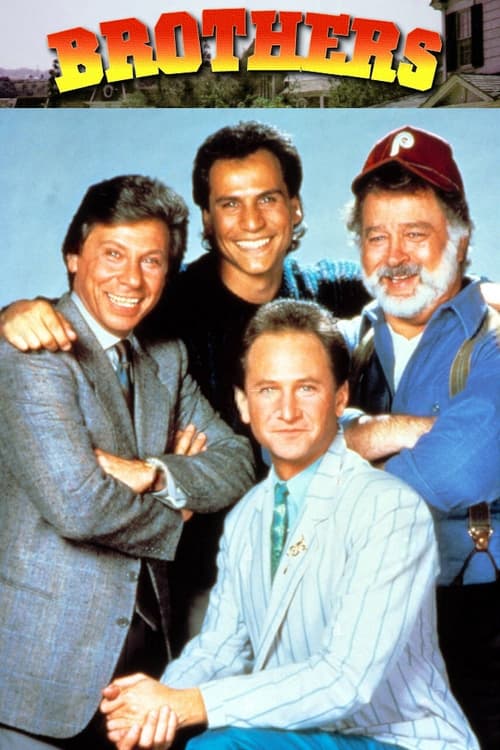




Brothers is an American sitcom that originally aired on the cable network Showtime from July 13, 1984, to May 5, 1989, totaling 115 episodes. It was produced by Gary Nardino Productions, in association with two separate divisions of Paramount Pictures: first by Paramount Video (1984–86) and by Paramount Television (1987–89). The show focuses on the three Waters brothers.
Contents
History
Development
David Lloyd, Greg Antonacci and Gary Nardino respectively created and developed Brothers in 1982, with the same format as what made it to the air. Lloyd, a veteran TV writer known for his work on The Mary Tyler Moore Show, Taxi and the then-new NBC sitcom Cheers, had the premise for this series suggested to him by his employers, TV producers Ed. Weinberger and Stan Daniels. Wishing to develop a new screenplay with a revolutionary theme, Lloyd took to Weinberger and Daniels' idea about exploring familial relationships with the presence of a major—and controversial—life change, that of a relative finally coming out and addressing his homosexuality. Lloyd fully developed the idea and assumed full credit for the creation of the project. He then partnered himself with then-Paramount Television president Nardino, who was looking to form an independent production company (he would leave Paramount in July 1983 to form Gary Nardino Productions), and Antonacci, a young actor-turned-director and producer, to write a pilot script with a modern, relevant point of view. The relationship of three adult brothers, inseparable and living in a world strongly underscored by masculinity, who soon have to confront the youngest brother's decision to be openly gay, quickly came to fruition in the screenplay aptly titled Brothers.
The project was originally shopped around to broadcast networks NBC and ABC, in hopes of being picked up for the 1983 fall television season. NBC agreed to screen the pilot due to Lloyd's work on Taxi and Cheers (both of which had aired on NBC during the 1982–1983 season), and due to the insistence of Weinberger and Daniels. Network executives (then headed by Brandon Tartikoff) saw the charm of the content, but were concerned about how homosexuality was going to be portrayed. NBC did put Brothers in the running of fall 1983 pilots, but ultimately passed on it, instead choosing a series from Weinberger, Mr. Smith, in its place. Lloyd, Antonacci and Nardino then offered Brothers to ABC, who instantly shot it down due to it dealing with gay themes. The creative team refused to give up hope on the project, and the same was said for its three leads, who from the beginning were Robert Walden (fresh off his Emmy Award-nominated role of Joe Rossi on CBS' Lou Grant), Paul Regina and Brandon Maggart. As the producers tried to find a new outlet to pitch it to, development was put on hold, allowing Regina to co-star in CBS' short-lived Zorro and Son (1983), and Maggart to assume a role on NBC's Jennifer Slept Here (1983–1984).
Eventually, Lloyd and company were approached by Showtime, who at the time had successfully begun to venture into the new field of original pay-cable TV series. In 1983, the channel had been the first in history to revive a canceled network series for original cable broadcasts, with The Paper Chase (which originally ran on CBS in 1978–1979). Showtime's mission was to produce and pick up original programming that was outside the boundaries of standard network TV fare, and saw Brothers perfectly fitting that mold. Both parties struck a deal that had its cast paid at the same rate as network stars, with a full out 26-episode order from the start. Fortunately, Lloyd didn't have to scramble around to recast two of his stars, since Regina and Maggart both saw their series get canceled, so his original choices were back in place. With the series' premiere in the summer of 1984, Showtime now boasted one more first — the first original situation comedy on cable TV.
Synopsis
Set in south Philadelphia, Brothers centered on the lives and relationships of the Waters brothers; oldest brother Lou (Brandon Maggart), a somewhat uncouth, but well-meaning construction foreman; middle brother Joe (Robert Walden), a retired placekicker for the Philadelphia Eagles and owner of a sports bar called The Point After; and the youngest brother, Cliff (Paul Regina), a sports journalism major and later, an aspiring chef.
In the premiere episode, Cliff shocks his family when he runs away from the altar on his wedding day. Instead of getting married, Cliff reveals to his family that he is gay. The pilot and following episodes centered on the efforts of Joe and Lou coming to terms with Cliff's long-held secret of his true sexual orientation, with both coping in their own unique way. Joe, who was definitely more sensible and open-minded, didn't see Cliff's sudden declaration of homosexuality robbing any aspect of their relationship. Lou assured his baby brother "Cliffie" that he loved and respected him but was convinced early on that what Cliff was feeling was just a phase and came up with numerous efforts to "cure" him of being gay. Cliff's relationship with the both of them was part brotherly, but also that of fathers and son, since Lou and Joe had almost 20 years on Cliff (their mother died when Cliff was an infant, followed a few years later by their dad; Lou and Joe raised Cliff for the majority of his youth). He was very much independent minded and kidded around with his brothers in the usual way siblings do, but at times looked to them for guidance and was very much overprotected by Lou and Joe.
Cliff, earnest, bright and very much determined to lead a fulfilled life now that he truly found himself, took many a stand on same-sex issues and discussions; throughout the first season, whenever a situation or argument ensued regarding his decisions in life, Cliff gave heartfelt statements on how proud and secure he was being his true self, and that nothing anyone could do could possibly change his inner desires. When the series began, he was still in college, majoring in sports journalism, while working part-time for Joe at The Point After. Following Cliff's first failed attempt at marriage, he resumed splitting rent with Joe in his sleek uptown apartment.
Philip Charles MacKenzie played Cliff's out-and-proud new friend Donald Maltby, a successful writer/magazine editor whom Cliff sought out friendship with for advice and support in the time leading up to his coming out. During and after the fact, Donald continued to be Cliff's voice of reason as he learned to navigate his way around the LGBT world. It was an otherwise unlikely friendship, but Donald's fey, queen-like behavior versus the masculinity of Cliff never got in the way, surprisingly. Donald's womanly flamboyance always unnerved Lou, and caused some mild, but humorous friction between them. However, Donald always managed to get the last laugh on Lou with his sharp humor. He lived in a cozy loft apartment which was another common setting for the stories. Cliff and Donald sometimes frequented The Velvet Spike, a local gay club/bar.
Themes and evolution
Originally, the storylines on Brothers were permeated with exclusively gay themes, as Cliff and Donald's dating exploits were featured, along with the heterosexual characters' involvement in such stories. This sprung forth the show's knack for providing a blurred line of differences between the mating habits and culture of both sexualities. Examples of topical gay stories included Cliff's casual intimate encounters with men and the points he still wanted to learn; Lou and Donald's efforts to infiltrate crooked local police officers who refused to help Cliff, when he was attacked by two homophobic men; Donald's coaching Joe into accurately convincing a former teammate that he was gay, in order to form a closer bond with the recently outed teammate; and in the second season, when Cliff landed a boyfriend in well-to-do Winston March III (guest star John Furey), who helped him become even more comfortable in his identity. Winston initiated a passionate kiss with him, at a function he hosted, in front of Cliff's entire family.
Stereotypes of both sexualities, both positive and negative, were for the most part avoided, and if they appeared, were not emphasized at the expense of comedy so they would not detract from the meaningful, character-driven dialogue. While a steep gay slant in the stories was present, they were not depicted only from the gay point of view; all characters' points of view in stories which explored sexuality shared the spotlight from episode to episode, sometimes shifting back and forth within a single episode. The series, as a result, was recognized as being clever and complex in this regard.
However, after the first two seasons, the writers started to downplay the wall-to-wall gay stories in favor of ones that were neutral to homosexual/heterosexual overtones. Just as this took place, additional characters started entering their own long-term relationships, which were depicted in a more standard sitcom fashion without sexuality being the key topic in an episode. Also, with Brothers being a Showtime original series, the allowance of strong language was taken advantage of heavily during the first and second seasons. By season three, with Paramount Television serious about the show's future in reruns, the scripts were cleaned up as well over the concern that the constant editing of coarse dialogue (Joe's habitual exclaiming of "son of a bitch" and "fuck" and "shit" peppered in accordingly) would be bad for syndication and revenues.
Later seasons
At the start of the third season, Joe began dating a voluptuous beauty named Sam (Mary Ann Pascal), a very materialistic real estate agent who was not only content with the physical aspect of their relationship, but also out to reap the benefits of an ex-pro athlete's bank account. During their mating dance, Sam became another regular patron at The Point After, where at times she found herself in competition with Kelly over practically everything. Penny, who had rapidly matured from a gentle, innocent high school senior to a wild, vivacious party girl with a punk hairdo, began working as a dancer at Girls, Girls, Girls & Beer, a local dance hall, during her sophomore year in college. Everyone else on the scene had mates that came and went, and Joe was no exception with Sam, as they were on-again, off-again for a while; while Sam chose not to play the field, Joe dated others. In the fourth-season premiere, perky, cultured Ann Marie Wagner (guest star Judith-Marie Bergan) showed up, as a girlfriend of Joe's who had been with him for six months. Joe and Annie decided to get married during the course of the episode, but after much meddling from a jealous Sam, and a discouraging ceremony speech from Donald (who presided over the restaurant ceremony), the two called it off. A few episodes later, Joe went into overdrive dating both Annie and Sam, but felt guilty; when he went to break the news to Annie that he had been playing her, she revealed that she had been cheating too, so the two parted ways mutually, leaving Sam, who encouraged an open relationship, as Joe's only romantic focus.
In time, Joe and Sam discovered that they had a whole lot more in common beyond money and status, and love blossomed. Kelly and Sam even learned to put their feuding aside, forming sort of a "girls' club" together with Penny and Donald. Meanwhile, Cliff, who graduated from college early in the fourth season, was on the verge on launching his journalism career with a local newspaper when he had an epiphany-–that he suddenly had the affinity for cooking—and announced to everyone that he was enrolling in culinary school. Joe, Lou, and especially Donald tried to save him for turning down the offer to work at the paper, but in the end, decided to throw caution to the wind after tasting Cliff's impressive tomato sauce. Later that year, after dating many young men on the fast track, aspiring yuppie Penny fell for none other than Jim Grant (Tommy Hinkley), a construction worker from Lou's company. Jim was actually from a very wealthy family, but loved the laborer's life better, resulting in his turning down the opportunity to helm his family's million-dollar enterprise in order to be truly happy. Their romance lasted a single season. It was also at this time that the youngest of Lou's kids, athletic teenage prodigy Louella (Yeardley Smith), became a regular.
Very special episodes
A couple of special episodes dealt with one of Joe's former teammates coming out, then feeling forced to admit that he was HIV-positive. Bubba Dean (guest star James Avery) actually revealed to Joe in a first-season episode that he was gay and had been holding a long-time torch for him. Then in a second season appearance, out of his fear of potentially spreading the virus, Bubba drops the news of his HIV infection at a party thrown by Donald. Since HIV and AIDS were not widely known to most Americans at the time, this episode had Joe learning about HIV and AIDS to better understand what his friend was going through so that he could offer support, as well as educating the public about HIV and AIDS and dispelling the myths about those who had contracted it and how it could be contracted.
Another episode in this category occurred in the second season, when Cliff learned that Connie (guest star Wendie Jo Sperber), his former fiancée whom he stood up at the altar in the pilot episode (although she was not seen in the pilot), was paying him a surprise visit after having spent a year being depressed — and gaining a lot of weight as the result of it. Cliff hesitated in making contact with her, but due to everyone's prompting they finally met face to face, and had a lot of hard feelings to address.
Veteran actress Billie Bird was the subject of a couple of two-parter episodes. Bird first appeared in the third season two-parter "Whose 'Golden Years' Is It Anyway?" (aired September 17 and 24, 1986), as Donald's Aunt Wilhelmina, who escapes to Philadelphia, and her nephew, when her family places her in a nursing home. Wilhelmina strikes up a friendship with Lou and ends up convincing him to keep her from being carted off back to the home; they promptly end up on the run without letting their family and friends know of their whereabouts. In the second part of this episode, an arrest warrant is brought out for Lou. Exactly a year later in season four, Wilhelmina shows up again in the two-parter "Las Vegas Serenade" (aired September 11 and 18, 1987), albeit through a VHS tape sent to Donald. It turned out to be her video will, which arrived with an urn of her ashes. Wilhelmina, in advance right before her death, set up an all-expenses paid trip to Las Vegas which the entire cast embarked on, with the exception of Kelly (Robin Riker began her temporary leave of absence with this episode). Donald and the gang were instructed by Wilhelmina to spread her ashes into the courtyard of the Golden Nugget Hotel & Casino while in Vegas. The trip was shot on location, mostly at the latter resort, and featured cameo appearances by Paul Anka and Jerry Lewis.
Scheduling
After premiering in July 1984, Brothers completed the run of its first season of 14 episodes in December of that year, with the now-popular Brothers Christmas Special (featuring guest star Andy García) serving as the season finale. Beginning in May 1985 and through the end of the 1987 season, Showtime usually ran new episodes of Brothers on a May to December season schedule, a common free-form timetable for any cable network. Each of the second through fourth seasons consisted of a 25 episode order with the final fifth season having the standard 25 episodes that other American series utilized.
The fifth season had its premiere moved up to June in 1988, and had its episodes spread out over the course of a year, with one or two new episodes airing each month. The pace of new episodes eased down during this season, first and foremost because of the 1988 Writers Guild of America Strike putting a halt to production during a portion of the season. After the strike ended, Showtime announced that Brothers was ending its run in 1989; episodes continued to air intermittently, since Showtime wanted a clear-cut five-year run while giving viewers enough to a chance to bid farewell to the series. The 25th episode of the fifth season, "The Road Yet Taken", was finally reached on May 5, 1989, and was the official series finale of Brothers. Then, a few weeks later on June 1, a "lost episode" produced during season three entitled "I Remember But I Don't Like It" aired. The episode featured most of the season three regulars, including Robin Riker but sans Mary Ann Pascal, and focused on Lou and Donald's most severe disagreement yet. As the others tried to figure out why the two were so angry at each other, a clip montage of Lou and Donald's relationship through the first three seasons was featured. Showtime presumably felt that this lost episode also served as a tribute to one of the show's key elements—the association between Lou and Donald. Showtime continued to air Brothers repeats on its schedule through late 1989.
For the majority of its original run, Brothers had aired Wednesday nights at 8/7c on Showtime, with episodes from its current season being repeated in various late night slots during the week on the premium cable network's schedule.
Cast
Robert Walden as Joe Waters
Paul Regina as Cliff Waters
Brandon Maggart as Lou Waters
Philip Charles MacKenzie as Donald Maltby
Hallie Todd as Penny Waters
Robin Riker as Kelly Hall (Seasons 1–4)
Mary Ann Pascal as Samantha "Sam" Booke Waters (Seasons 3–5)
Yeardley Smith as Louella Waters (Seasons 4–5)
Tommy Hinkley as Jim Grant (Season 4)
Timothy Williams as Mike Chandler (Season 5)
Cathryn Hacker as Caroline Waters (Season 5)
Production notes
Opening sequence and presentation
The Brothers title theme was a jazzy, synthesized piece written by Marcus Barone, Joe Diamond and Gloria Nissenson, with opening vocals performed by Barone.
As the title sequence opens, videotaped exterior scenes of Philadelphia are shown one at a time as the show's title is spelled out, one letter at a time, across the screen. The title formation is set on a half-circular curve. During this, lead singer Barone has a conversation with two other men in preparation for them to sing the theme song with him. Apparently, they are supposed to be posing as the Waters brothers, to give viewers the illusion that they, and not the hired singers, are the ones harmonizing the tune. Following this, a chorus of shoop-do-wahs serve as a bridge between the dialogue and the main part of the song.
The opening credits featured an artistic montage of actual photos from Walden, Regina, and Maggart's childhood and young adult years (although the first photo of young Lou in the sequence was actually that of Brandon Maggart's son, Garett Maggart, when he was a baby). Also featured was 16mm film footage of young Paul Regina, labeled on a film strip in the sequence as "Cliff, age 4 yrs". This montage segued into a group photo of the Waters brothers in the current day, which in turn displayed singular portraits of them one at a time as their credits were given on screen. All cast member photos were set against a blue background. A time-lapsed animation version of the group photo then lifts up to reveal multiple photos of the brothers in various scenes from the show's set. From the pilot episode through the end of season three, Robin Riker and Hallie Todd's names were listed at the bottom of this section, while the pictures floated against a sky background.
The final part of the opening sequence is a videotaped scene of the Waters brothers, finishing their lip-syncing of the show's theme song in front of a candy store named "Babe's". For the first two seasons, "and Philip Charles MacKenzie as Donald" appeared during this scene, followed by creator and producer credits before the sequence faded. During the entire third season, a computerized blue background with a digital cut-out of MacKenzie appeared with his credit before cutting to the "Babe's" scene. Starting with the fourth-season premiere, the photos of Robin Riker (now credited as Robin Riker-Hasley) and Hallie Todd were featured for the first time over the floating pictures animation, flipping up one at a time, until the last photo is that of MacKenzie, who now appears in a proper portrait. The last three cast portraits were set in blue backgrounds to match those of Walden, Regina, and Maggart's. Also, from this point on, creator and producing credits no longer appeared in the opening's last scene.
Episodes
Season 5: 1988–89
Notes
Music scores
All five seasons of the show were musically scored by Dan Foliart and Howard Pearl.
Foliart composed scores for Home Improvement during its entire eight-year run (1991–99). In 1994, Robin Riker would join the cast of Home Improvement sister series Thunder Alley, which Pearl scored for.