



Bombardier Inc. (French: [bɔ̃baʁdje]) is a Canadian manufacturer of business jets. Headquartered in Montreal, the company was founded in 1942 in Valcourt by Joseph-Armand Bombardier to market his snowmobiles, later to become one of the world's largest producers of aircraft and trains until divestiture in the 21st century.
During the 1970s and 1980s, the company diversified into public transport vehicles and commercial jets, and it became a multinational corporation. Bombardier grew particularly fast at the end of the 1980s, when the turnover multiplied sixfold within six years. At that time, it was North America's most important producer of railway vehicles, Canada's most important aerospace manufacturer and the worldwide leading snowmobile maker. The growth came mainly from buying failing government-owned companies at a low price and orchestrating a turnaround.
However, the launch of the CSeries aircraft sent Bombardier into deep debt, pushing it to the brink of bankruptcy by 2015. As a result, the company sold nearly all of its operations except business jet manufacturing.
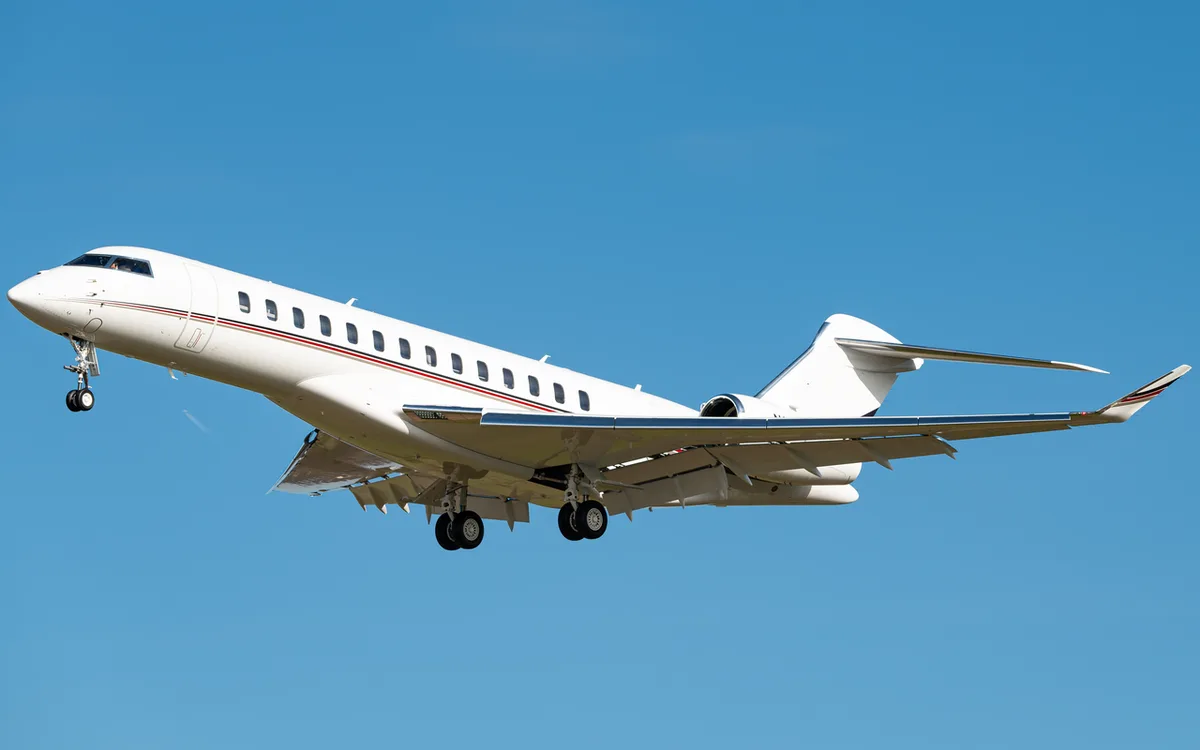
Bombardier manufactures two families of corporate jets, the Global series and the Challenger series. On May 18, 2021, the Global 7500/8000 series during testing became the first business jet to break the sound barrier and the fastest civil aircraft since the Concorde. With deliveries of 138 business jets in 2023, Bombardier was the number one manufacturer of business jets in the world.
Contents
Corporate affairs
The key trends of Bombardier are (as at the financial year ending December 31):
Divested lines of business
Commercial aviation
In 1986, Bombardier acquired Canadair for C$120 million from the Government of Canada after it recorded the largest corporate loss in Canadian history.
In 1989, the company acquired Short Brothers.
By 1990, the first product of the company, the Ski-Doo snowmobile, had become its weakest part gaging up deficits and high inventories.
In 1990, it acquired Learjet. In 1992, the company acquired de Havilland Canada from Boeing.
In 1995, the company founded Flexjet. In December 2013, the division was sold for $195 million.
On June 29, 2016, Bombardier delivered the first CSeries CS100 aircraft (now called the Airbus A220) to Swiss International Air Lines. Air Canada placed an order for the aircraft one day earlier.
In April 2016, Delta Air Lines placed an order for the aircraft. On September 26, 2017, after Boeing complained that Bombardier was selling the CS100 to Delta Air Lines below cost due to subsidies from the governments of Canada and Quebec, the United States Department of Commerce proposed a 219% tariff on the aircraft. Boeing's complaint stated that the CS100 planes were being sold at US$19.6 million each, below the US$33.2 million production cost. The governments of Canada and the United Kingdom threatened to stop ordering Boeing aircraft since the company was putting aerospace jobs at risk. On January 26, 2018, the United States International Trade Commission overturned the tariffs. Boeing did not appeal.
In July 2018, Airbus acquired a 50.01% stake in the CSeries for one Canadian dollar, with an option to acquire the remaining interest by 2024. Airbus built a second CSeries assembly line at its A320 assembly facility in Mobile, Alabama.
In November 2018, the company announced the sale of its turboprop passenger aircraft unit to an affiliate of Viking Air (which later became De Havilland Canada). It also announced 5,000 layoffs.
Bombardier Capital
Bombardier Capital (BC), a subsidiary of Bombardier Inc., was formed during 1973 in Colchester, Vermont.
BC provided secured financing for a dealer's inventory that was purchased from distributors or manufacturers of consumer and recreational products, especially Bombardier Recreational Products, in the United States, Canada and Europe. Their clients consisted of Sea-Doo and Ski-Doo dealers, as well as retailers in multiple industries, primarily manufactured housing, recreational boating and specialty and recreational vehicles. BC also provided a wide variety of domestic/international loans, asset management and leasing services for business aircraft and commercial/industrial products, including technology and telecommunication equipment.
In August 1997 CGI Inc. and BC announced a strategic agreement to offer their clients value-added services. CGI would offer information technology to BC's clients, and BC would provide project financing to CGI's clients.
That same year, BC began transitioning loan origination and servicing to Jacksonville, Florida. Bombardier Capital's operations were located at 12735 Gran Bay Parkway West, Suite 1000 in the Flagler Center. BC ceased loan originations in 2001, then in 2005, BC sold their Inventory Finance Division to GE Commercial Finance before shutting down operations.
Military
The company acquired the rights to the Volkswagen Iltis in 1981. Production ceased in 1989.
When UTDC was acquired by Bombardier in 1991 several military products were added:
UTDC 24M32 - HLVW military trucks based on the Steyr 91 (Percheron)
MLVW military trucks based on the M35 2-1/2 ton cargo truck
In 2003, the company sold its arms industry division in Canada. Military Aviation Services was sold to SPAR Aerospace. Land-based arms industry products made by Urban Transportation Development Corporation ceased operations.
Public transport bus in Ireland
In the late 1970s, in the Republic of Ireland, CIÉ (now Bus Éireann and Dublin Bus) commissioned a range of single and double-decker buses to be designed and produced.
CIÉ looked for partners to build these buses in Ireland, eventually finding two: Bombardier, and the United States–based General Automotive Corporation (GAC) from Ann Arbor, Michigan. The two companies formed a new company Bombardier Ireland Limited, 51% owned by Bombardier and 49% owned by GAC. In August 1983, Bombardier sold its shares to GAC, with the company renamed GAC Ireland Limited.
The prototypes were devised in Germany and production of 51 express coaches (KE type) and 366 double-decker buses (KD type) were assembled between 1980 and 1983 at a facility in Shannon, County Clare. They remained in service until 1997 and 2000, respectively. Some surviving examples are now exhibited at the National Transport Museum of Ireland at Howth Castle.
Rail equipment
The company diversified into rail transport after the 1970s energy crisis reduced demand for snowmobiles.
In 1974, the company received its first order – to build MR-73 trains for Société de transport de Montréal for use on the Montreal Metro.
In 1975, the company acquired Montreal Locomotive Works. It was sold to General Electric in 1988.
In 1982, the company won a contract from New York's Metropolitan Transportation Authority to build 825 R62A cars for the New York City Subway for $663 million.
In 1985, the company ceased manufacturing locomotives and concentrated on producing passenger train rolling stock. It acquired a 45% stake in La Brugeoise et Nivelles (formerly BN Constructions Ferroviaires et Métalliques) based in Bruges in 1986, the assets of U.S. railcar manufacturers Budd Company and Pullman Company in 1987, and ANF Industrie based in Crespin, Nord, France in 1989. A series of acquisitions in the United Kingdom, Germany, Switzerland, Canada, and Mexico further increased operations.
In 1996, the company was selected as the lead developer for the Acela Express trains, the fastest trains in North America, in a $710 million contract. Problems with the trains resulted in lawsuits between the company and Amtrak.
In 2001, Bombardier acquired Adtranz (DaimlerChrysler Rail Systems), a manufacturer of trains which were widely used throughout Germany and Great Britain, becoming one of the largest manufacturers of railway rolling stock in the world. This division produced the Bombardier Turbostar.
In 2005, it launched the Bombardier Zefiro high-speed rail, with speeds of 200–380 km/h (120–240 mph), for the Ministry of Railways (China).
In 2007, Bombardier won a $14m contract from LDZ of a total $45m to improve the signalling system on the East-West Rail Corridor of Latvia.
Bombardier Recreational Products
In January 1934, a blizzard prevented Joseph-Armand Bombardier from reaching the nearest hospital in time to save his two-year-old son, Yvon, who died from appendicitis complicated by peritonitis.
Bombardier was a mechanic who dreamed of building a vehicle that could "float on snow". In 1935, in a repair shop in Valcourt, Quebec, he designed and produced the first snowmobile using a drive system he developed that revolutionized travel in snow and swampy conditions.
In 1937, he patented and sold 12 of the 7-passenger "B7" snow coaches. They were used in rural Quebec to take children to school, carry freight, deliver mail, and as ambulances. In 1941, Bombardier opened a factory in Valcourt.
In 1942, L'Auto-Neige Bombardier Limitée ("Bombardier Snow Car Limited") was founded in Valcourt.
During World War II, the Government of Canada issued wartime rationing regulations. Bombardier customers had to prove that snowmobiles were essential to their livelihood in order to buy one. The company then shifted its focus to the arms industry.
In 1947, during a blizzard in Saskatchewan, the company received positive press coverage when army snowmobiles resupplied isolated radio communication towers.
In 1948, the Government of Quebec passed a law requiring all roads to be cleared of snow; Bombardier's sales fell by nearly half in one year. Armand Bombardier therefore decided to diversify his business, first by producing tracked snowplows sized specifically for use on municipal sidewalks, replacing horse-drawn vehicles, then by making all-terrain vehicles for the mining, petroleum, and forestry industries.
The machines had removable front skis that could be replaced with front wheels for use on paved or hard surfaces, thus providing greater utility to his large snowmobiles. In 1951, the wooden bodies were replaced with sheet steel, and these vehicles were powered by Chrysler flathead six-cylinder engines and 3-speed manual transmissions.