




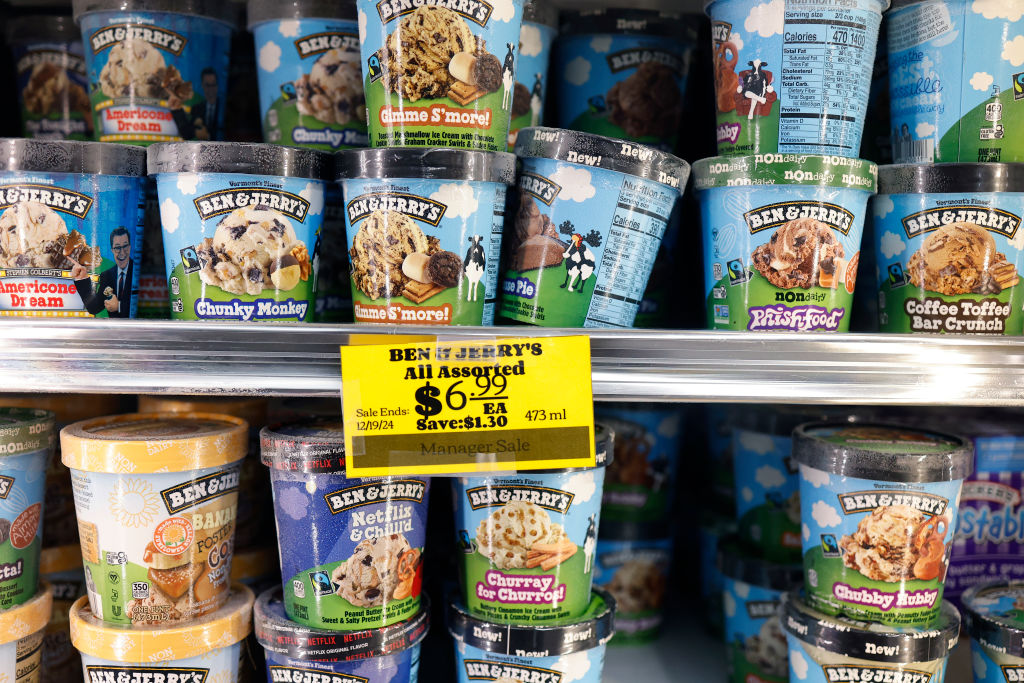
Ben & Jerry's Homemade Holdings Inc. is an American company that manufactures ice cream, frozen yogurt, and sorbet. Founded in 1978 in Burlington, Vermont by the eponymous Ben Cohen and Jerry Greenfield, the company went from a single ice cream parlor to a multinational brand over the course of a few decades. The company was sold in 2000 to the British multinational conglomerate Unilever, now The Magnum Ice Cream Company, but operates as an independent subsidiary. Its present-day headquarters is in South Burlington, Vermont, with its factory in Waterbury, Vermont.
Ben & Jerry's is known for their original flavors, many of which incorporate foods and desserts mixed with ice cream. Some of these flavors have been themed after musicians, comedians, and public figures, such as Jerry Garcia, Stephen Colbert, Jimmy Fallon, Colin Kaepernick, and Phish. The company and its two founders have also been noted for their political activism and advocacy for social justice. This includes the way their products have been manufactured, marketed, and distributed.
Contents
History
Founding
The company was founded by Ben Cohen and Jerry Greenfield, who had been friends since their childhood in Merrick, New York. Although Greenfield finished college, he was unable to get into medical school. Cohen dropped out of school. In 1977, Cohen and Greenfield incorporated a business, planning to open a bagel shop, but found the requisite equipment was too expensive. They instead completed a correspondence course on ice cream making from Pennsylvania State University's creamery. Cohen has severe anosmia, a lack of a sense of smell, so he relies on mouthfeel and texture to provide variety in his diet. This led to the company's trademark chunks being mixed in with their ice cream. On May 5, 1978, with a $12,000 investment (equivalent to $59,000 in 2025), Cohen and Greenfield opened an ice cream parlor in a renovated gas station in downtown Burlington, Vermont. In 1979, they marked their anniversary by holding the first "free cone day", now an annual event at every Ben & Jerry's store, from that year to 2019, and resuming in 2023.
In 1980, Cohen and Greenfield rented space in an old spool and bobbin mill on South Champlain Street in Burlington and started packing their ice cream in pints. The first Ben & Jerry's franchise opened in 1981, on Route 7 in Shelburne, Vermont. In 1983, Ben & Jerry's ice cream was used to build "the world's largest ice cream sundae" in St. Albans, Vermont; the sundae weighed 27,102 pounds (12,293 kg). That same year, the cows on their cartons were redesigned by local artist Woody Jackson.
In 1984, Häagen-Dazs wanted to limit distribution of Ben & Jerry's by its distributors in Boston, prompting Ben & Jerry's to file suit against the parent company, Pillsbury, in its "What's the Doughboy Afraid Of?" campaign. In 1987, Häagen-Dazs again tried to enforce exclusive distribution, and Ben & Jerry's filed a second lawsuit against the Pillsbury Company.
In 1984 Cohen and Greenfield sold shares in the company in a Vermont only IPO, raising $750,000 to finance expansion. Cohen retained a 50% stake in the firm while Greenfield retained 10% and moved to Arizona.
In 1985, the Ben & Jerry's Foundation was established at the end of the year with a gift from Ben & Jerry's to fund community-oriented projects; it was then provided with 7.5% of the company's annual pre-tax profits. In 1986, Ben & Jerry's launched its "Cowmobile", a modified mobile home used to distribute free scoops of Ben & Jerry's ice cream in a unique, cross-country "marketing drive", driven and served by Ben and Jerry themselves. The "Cowmobile" burned to the ground outside of Cleveland four months later, but there were no injuries. Ben said it looked like "the world's largest baked Alaska".
Unilever era
In April 2000, Ben & Jerry's sold itself to British multinational food giant Unilever for $326 million ($607 million in 2025 accounting for inflation). In the acquisition agreement, Unilever agreed to carry on the company's tradition of engaging "in these critical, global economic and social missions". Following the acquisition, both founders remained employed at the company, though not in a position of operational or managerial responsibility, though Cohen remained on the governing board of directors.
In 2003, the company shut down the factory in North Springfield and the distribution facility in Bellows Falls to focus on expanding the facility in Saint Albans.
In 2010, Jostein Solheim, a Unilever executive from Norway, was appointed CEO. In 2018, Matthew McCarthy, previously a Unilever executive, was appointed CEO, replacing Solheim.
In 2019, Ben & Jerry's had production facilities in Saint Albans, Vermont; Waterbury, Vermont; Hellendoorn, Netherlands; and Be'er Tuvia, Israel. The Israeli facility was sold to its local licensee in June 2022.
On May 15, 2023, the company announced Dave Stever as the new CEO after the preceding CEO, Matthew McCarthy, retired from the company.
On March 18, 2025, the company stated in a court filing that Unilever had unlawfully removed Stever as CEO in retaliation for social and political activism.
On July 10, 2025, the company announced Jochanan Senf as the new CEO.
In 2001, Ben & Jerry's U.S. completed the transition to "Eco-Pint" packaging, which packaged all pint flavors in environmentally friendly unbleached paperboard Eco-Pint containers, a decision it later reversed. The use of brown-kraft unbleached paperboard had been a critical first step toward a totally biodegradable pint made without added chlorine.
Due to what they described as increasing supply, quality, and cost challenges, Ben & Jerry's discontinued the use of the Eco-Pint in 2006, transitioning to a pint container made out of a bleached paperboard that it said was more readily available.
Unilever spin-off
On March 19, 2024, Unilever announced it would divest its ice cream brands and cut 7,500 jobs in order to make "a simpler, more focused and higher performing Unilever." Included in the spin-off are Ben & Jerry's, Cornetto, Magnum, Talenti, and Wall's. The divestment completed in July 2025 with the creation of The Magnum Ice Cream Company (TMICC).
In 2025, Ben & Jerry's independent board accused Unilever of violating the company's independence as stipulated in the merger agreement the two companies signed in 2000. The board said that Unilever had prevented it from posting on social media in support of Palestinian refugees, the First Amendment rights of student protestors and a ceasefire in the Gaza war. The board also said that Unilever had blocked its donations to Jewish Voice for Peace and the Council on American-Islamic Relations. It also alleged that Unilever had blocked more recent posts in opposition to Donald Trump's second presidential agenda, and fired CEO David Stever in retaliation for the company's political stances.
On September 9, 2025, the co-founders of Ben & Jerry’s wrote to the board of The Magnum Ice Cream Company (TMICC) and Magnum’s potential investors, requesting that the brand be released from the conglomerate. On September 16, Ben Cohen announced that Jerry Greenfield was leaving Ben & Jerry's due to his allegations of censorship on the issue of Palestine and Israel and other social justice issues. Cohen accused Unilever of conducting a "corporate attack on free speech" after it blocked the development of a flavor calling for peace in Gaza.
According to Magnum, an audit of the Ben and Jerry's Foundation, commissioned by Magnum, found that it had deficiencies in financial controls and governance. Anuradha Mittal, chair of the foundation's board, called the audit "a manufactured inquiry - engineered to attempt to discredit me."
Original flavors and sundaes
The most popular Ben & Jerry's flavor had been "Cherry Garcia" for more than a decade until 2013, when a survey taken of the general public found Cookie Dough was the winner with 60%. The company website states (as of December 2020) that the most popular flavor is "Half Baked", with "Cherry Garcia" placing second, and "Chocolate Fudge Brownie" following in third. It is unclear to what degree the popularity of flavors reflects their availability. In the United Kingdom, "Cherry Garcia" ice cream has disappeared from supermarkets, and those who desire it must obtain it from a Ben & Jerry's Scoop Shop.
The "Vermonster" is a large ice cream sundae served in a "Vermonster Bucket" in Ben & Jerry's "Scoop Shops". Its ingredients are 20 scoops of ice cream, four bananas, four ladles of hot fudge, three chocolate chip cookies, one chocolate fudge brownie, 10 scoops of walnuts, two scoops each of any four toppings, and whipped cream. It contains 14,000 calories (59,000 kJ), and 500 grams (18 oz) of fat. Since 2009, the Vermonster Challenge is an annual charity event held by Ben & Jerry's in which teams of four compete to finish a Vermonster and win free ice cream for a year.
"Chubby Hubby" consists of vanilla malt ice cream swirled with fudge and peanut butter, and containing pretzel nuggets covered in fudge and filled with peanut butter. During the month of September 2009, Ben & Jerry's, in partnership with Freedom to Marry, renamed "Chubby Hubby" to "Hubby Hubby," in celebration of the legalization of same-sex marriage in the company's home state of Vermont. The carton featured the image of two men in tuxedos getting married beneath a rainbow.
On March 13, 2012, Ben & Jerry's announced it would be changing the name of one of its ice cream flavors in the UK in support of equal marriage rights for same-sex couples. "Oh! My! Apple Pie!" would become "Apple-y Ever After" and tubs would feature a gay couple atop a wedding cake decorated with rainbows.
"Chocolate Chip Cookie Dough" was temporarily renamed "I Dough, I Dough" in the United States during the summer of 2015. This was in celebration of United States Supreme Court's ruling in support of same-sex marriage. The proceeds from sales were to go to the Human Rights Campaign (a nonprofit advocacy group for LGBT rights).
Social and political issues
Commercial
The Center for Science in the Public Interest, a consumer-advocacy group, urged Ben & Jerry's to stop labeling their ice cream as "all natural" due to the company's use of corn syrup, alkalized cocoa, and other chemically modified ingredients. In September 2010, the company agreed to stop labeling their ice cream and frozen yogurt as "all natural".
In 2011, Ben & Jerry's released a flavor named Schweddy Balls, in homage to the Saturday Night Live (SNL) skit of the same name. This received protests from One Million Moms, a project of the conservative Christian group American Family Association, who said that the name was too explicit for grocery store shelves. Spokesperson Monica Cole explained to the media: "I realize it could be a lot worse, but are they going to progressively get worse if we don't say something? Maybe they'll think twice before they come up with another inappropriate name for ice cream." However, the expression of disdain was not unanimous among U.S. parents, as mother Gina Ragusa said to The Huffington Post: "We just think it's funny, that's all, and honestly we all really want to try it", adding that she consistently checks for the item's availability at her local supermarket. Actor Alec Baldwin, who appeared in the SNL skit as baker Pete Schweddy, hosted the September 24, 2011, episode of the 37th season of the show and responded to the protests by stating that a new flavor called "Go Fudge Yourself" had been produced for those in opposition to the tribute. Following the initial release of the flavor, Baldwin informed the media that "thanks to Ben & Jerry's, the goodness of the Schweddy family recipe won't go with me to the great beyond," as he had previously feared that his association with the SNL episode would remain permanent until his death.
Political
Following rumors that suggested Ben & Jerry's supported the defense of Mumia Abu-Jamal — who was convicted in 1982 of killing Philadelphia Police officer Daniel Faulkner — the company confirmed that Cohen did sign a petition, as a private citizen, asking that "the system of American justice be followed fully in the case".
Between 2005 and 2008, Ben & Jerry's collaborated with polar explorer Marc Cornelissen and the World Wide Fund for Nature (WWF) to run the Climate Change College, an initiative to train young people in communications and campaigning around climate change.
In 2006, Ben & Jerry's released a flavor of ice cream called "Black and Tan", which was named after the alcoholic drink of the same name, made by mixing stout with pale ale. After it was made available to Irish consumers, a controversy emerged in Ireland due to the name of the flavor being the nickname of the Black and Tans, a controversial British paramilitary force with a reputation for brutality in the Irish War of Independence.
In 2012, Vermonters for a Just Peace in Palestine/Israel (VTJP) contacted Ben Cohen, Jerry Greenfield, and the CEO of Ben & Jerry's after learning that ice cream produced by the Ben & Jerry's franchise in Israel was being sold in Israeli settlements in the West Bank and East Jerusalem. Leafleting occurred at locations in Vermont, New York, and California on 'Free Cone Day' in April 2013 and April 2014. As of November 2014, 232 organizations across the United States and in seventeen countries worldwide have signed a letter written by VTJP calling on Ben & Jerry's to end its commercial ties to such settlements.
In late April 2014, Ben & Jerry's signed on to the "Fight for the Reef" campaign, a partnership between the World Wide Fund for Nature (WWF)-Australia and the Australian Marine Conservation Society (AMCS) to help protect the Great Barrier Reef. Queensland Premier Campbell Newman and federal senator Matt Canavan both said in statements that Ben & Jerry's was making misleading statements that exaggerated the detrimental impact that proposed government programs would have on the reef, and Environment Minister Andrew Powell said, "The only people taking a scoop out of the reef is Ben and Jerry's and Unilever. If you understand the facts, you'd want to be boycotting Ben and Jerry's". Australian Ben & Jerry's brand manager Kalli Swaik responded, "Ben & Jerry's believes that dredging and dumping in world heritage waters surrounding the marine park area will be detrimental to the reef ecology. It threatens the health of one of Australia's most iconic treasures."
Sales in West Bank
On July 19, 2021, Ben & Jerry's announced that it plans to end sales in Occupied Palestinian Territory, within which Israeli settlements are considered illegal under international law. Due to the refusal of Ben & Jerry's Israel — the local franchisee since 1987 — to comply with this policy, the company statement said it did not plan to renew the franchise in 2022. The company had previously suffered criticism and boycotts for operating in the region, most notably from Vermonters for a Just Peace in Palestine/Israel. The company statement referenced this, noting that it was responding to "the concerns shared with us by our fans and trusted partners", while confirming that sales operations would continue in Israel beyond 2022 "through a different arrangement".
The policy decision was met with mixed reactions. USA Today described the decision as "one of the strongest and highest-profile rebukes by a well-known company of Israel's policy of settling its citizens on war-won lands". The news drew some harsh criticism from Israeli public figures, with foreign minister Yair Lapid tweeting: "Ben & Jerry's decision is a disgraceful capitulation to antisemitism, to BDS, to all that is evil in the anti-Israeli and anti-Jewish discourse." Pro-Palestinian and anti-apartheid groups welcomed the move.
It has also been suggested that the decision — while not technically a boycott, given the lack of legal recognition of the Palestinian Territories as a formal part of Israel under Israeli law — may run foul of anti-boycott laws in a number of US states. On August 3, 2021, governor of Florida Ron DeSantis announced that he had placed parent company Unilever on a list of "Scrutinized Companies that Boycott Israel" as a result of Ben & Jerry's decision to "engage in the BDS movement". On September 9, the State of Arizona committed to totally divest from Unilever by September 21. On September 14, the State of New Jersey also gave Unilever 90 days' notice of divestment action.
In June 2022, Unilever agreed to sell its business interests in Israel to the Israeli branch of Ben & Jerry's under an agreement in which the latter will be able to sell in both Israel and the West Bank, provided it uses only Hebrew and Arabic labels in the products. On July 5, 2022, Ben & Jerry's sued its parent company to block the sale on the grounds that it threatened to undermine the integrity of the brand and that it was inconsistent with its values to sell its ice cream in the occupied West Bank. When Unilever acquired the company in 2000, Ben & Jerry's board kept protection over its brand. On July 15, minutes before that first scheduled hearing in the lawsuit, both Ben & Jerry's and parent company Unilever announced they would pursue dispute resolution via mediation instead.
Social
In February 2012, a Ben & Jerry's franchise near Harvard University created a limited edition frozen yogurt flavor named "Taste the Lin-Sanity" in honor of Asian-American basketball player Jeremy Lin, a Harvard alumnus. At inception, the product contained vanilla frozen yogurt, lychee honey swirls, and fortune cookie pieces, leading to a widely publicized controversy about racial stereotyping due to the association of the fortune cookie ingredient with Chinese culture. That ingredient was later replaced with waffle cookies, as the fortune cookies became soggy and the franchise received returns from customers. Ben & Jerry's general manager for Boston and Cambridge explained to the media: "we obviously weren't looking to offend anybody and the majority of the feedback about it has been positive." Ben & Jerry's released an official statement shortly after the launch of the product, apologizing to those who were offended.
In September 2014, anti-hazing activists raised concerns about the ice cream flavor "Hazed & Confused", which had been released earlier that year. The concern was that the name could be perceived as belittling of hazing and bullying problems. The company has noted that the name was based on the word hazelnut and a play on the phrase "dazed and confused", which is both a song popularized by Led Zeppelin and a 1993 film. The decision was made in October to not rename the flavor.
Attempts by migrant laborers to directly contact Ben & Jerry's company officials in Waterbury, Vermont, during 2018, resulted in arrests by Immigration and Customs Enforcement.
During the 2020 protests against racial prejudice following the police murder of George Floyd, Ben & Jerry's publicized a statement encouraging Americans to "dismantle white supremacy" and face "the sins of our past". Later that month, they endorsed the "Defund the Police" movement.
In 2023, Ben & Jerry's received criticism for posting a tweet on Independence Day, claiming that the United States was founded on "stolen Indigenous land" and that Mount Rushmore should be returned to the Lakota people. In reply, the Nulhegan Band of the Coosuk Abenaki Nation expressed interest in acquiring the Ben & Jerry's headquarters in Vermont, which is located on historical Abenaki territory. The company never replied to this request.