


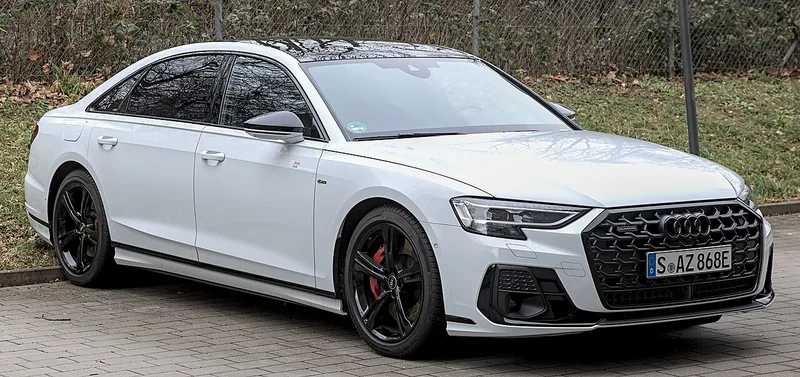
The Audi A8 is a full-size luxury sedan manufactured and marketed by the German automaker Audi since 1994. Succeeding the Audi V8, and currently in its fourth generation, the A8 has been offered with either front- or permanent all-wheel drive and in short- and long-wheelbase variants. The first two generations employed the Volkswagen Group D platform, with the current generation deriving from the MLB platform. After the original model's 1994 release, Audi released the second generation in late 2002, the third in late 2009, and the fourth and current iteration in 2017. Noted as the first mass-market car with an aluminium chassis, all A8 models have used this construction method co-developed with Alcoa and marketed as the Audi Space Frame.
A mechanically upgraded, high-performance version of the A8 debuted in 1996 as the Audi S8. Produced exclusively at Audi's Neckarsulm plant, the S8 is fitted standard with Audi's quattro all-wheel drive system. The S8 was only offered with a short-wheelbase for the first three generations, being joined by a long-wheelbase variant for the fourth generation.
In March 2026, reports stated that Audi had stopped taking new A8 orders in Germany from 18 February 2026, signaling the wind down of the current D5 generation. At the time, Audi has confirmed a successor is in the works, and availability in other markets was reported to depend on remaining inventory. The development followed broader reports that Audi was shifting strategic focus toward SUVs and electric vehicles.
Contents
D2 (Typ 4D; 1994)
Development
In 1982, Ferdinand Piëch signed an agreement with Aluminum Company of America. The objective was to design and develop a car that would be substantially lighter than any other vehicles in its class (to compensate for the fact that standard all-wheel drive was around 100 kg (220 lb) heavier than competitors' rear-wheel drive). In the late 1980s, it was decided that the target vehicle would be a successor to the V8 (Typ 4C) flagship introduced in 1988. By 1990, a final design by Chris Bird and Dirk van Braeckel was chosen and frozen for series production in mid-1991. In September 1993, the Audi Space Frame (ASF) Concept was unveiled at the 1993 Frankfurt Motor Show (IAA) as a D2 Typ 4D prototype in polished aluminium. Pilot production began in December 1993 and development ended in early 1994, at a total cost of $700 million (£418.1 million).
Introduction
The Audi A8 (Typ 4D) was presented in February 1994 and debuted at the 1994 Geneva Auto Show in March, with full-scale factory production commencing in June 1994, although it was not until October 1996, for the 1997 model year that it became available in North America. Unlike its predecessor, the Audi V8 model, which was built on an existing steel platform, the A8 debuted on the then-new Volkswagen Group D2 platform, an all aluminium monocoque, marketed as the "Audi Space Frame" (ASF), which helped to reduce weight and preserve structural rigidity. The saloon/sedan was offered in both the A8 (standard wheelbase), and the A8 L extended or long-wheelbase (LWB) version. The A8 L adds 5 inches (127 mm) of rear legroom. Updates to the car in 1997 included the addition of six interior airbags. The A8 was designed as a competitor to fellow German rivals Mercedes Benz S Class and the BMW 7 Series. It also competed against the British Jaguar XJ and the Japanese Lexus LS.
In 1997, Audi introduced the first series production electronic stability control (ESP) for all-wheel drive vehicles (Audi A8 and Audi A6)– the world's first production cars with both front and rear side airbags.
For 1997, the new A8 was available with either front-wheel drive (FWD), or the Torsen-based quattro permanent four-wheel drive. The FWD models are powered by a 2.8-litre V6 engine, producing 142 kW (193 PS; 190 bhp), and a 3.7-litre V8 engine producing 169 kW (230 PS; 227 bhp), while the quattro received a 4.2-litre V8 producing 221 kW (300 PS; 296 bhp).
The A8 is available with standard luxury amenities, including dual-zone climate control, wood and leather interior trim, 14-way power and heated seats, and an enhanced Bose audio system.
In 1998, upon assuming office, German Chancellor Gerhard Schröder chose the A8 to be his official state car, marking a break from tradition, as his predecessors had preferred Mercedes-Benz S-Class models. Upon being re-elected to second term in 2002, he moved on to the next generation A8's sister model Volkswagen Phaeton.
In 1999, Audi's flagship received side curtain airbags, new colours, and restructuring of option packages. The North American "warm weather package" added a solar sunroof, which allows the interior ventilation fans to run, keeping the interior cool while the car is parked with the engine turned off. Changes to all models included a larger passenger-side mirror, and a first aid kit located in the rear centre armrest.
Coupé (prototype)
In 1997, IVM Automotive of Munich, Germany built a two-door Audi A8 Coupé. The car was unveiled at the 1997 Geneva Motor Show. Audi contracted IVM to build the prototype, and was considering production of the vehicle. The coupé had a re-engineered aluminium body, shorter than the production A8 saloon. Like the Mercedes-Benz CL-Class, there was no central "B" pillar, giving the car a seamless design with a gradually sloping roofline. The car included custom leather seats which could seat four. Ultimately, Audi decided not to put the A8 Coupé into production, citing lower-than-expected sales figures for the similar BMW 8 Series (E31) and Mercedes-Benz S-Class Coupé. Only one A8 Coupé was ever built. The single prototype, painted in a colour called "Ming Blue pearl", remains the property of IVM Automotive, and resides in Munich. Its last public appearance was in 2002 on a series of test drives.
S8
Audi introduced the S8 4.2 quattro into the European market in 1996. The S8 followed the naming convention of other high-performance Audi "S" models, such as the Audi A6-derived S6. In some markets such as the UK, the S8 was only available with the automatic transmission. Cosmetically, Audi differentiated the S8 from the A8 with solid aluminium alloy door mirror housings, chrome-effect beltline and lower front grille trim, and polished twin exhaust pipes, along with subtle "S8" badging. 14-way power adjustable and heated sports front seats with memory function were fitted as were heated rear seats. Standard alloy wheels were 18-inch cast aluminium alloy "Avus" six-spoke style. After the 1999 facelift, 20-inch polished nine-spoke RS wheels became an option. In 2002, 18-inch nine-spoke RS wheels became a no-cost option.
At the same time of the A8's facelift in late 1999, the S8 received the same cosmetic upgrades. This update marked the release of the S8 to the North American market. Production of the D2 series S8 ended in September 2002.
The D2 series S8 featured an uprated, 250 kW (335 hp) version of the 4.2-litre V8 with four valves per cylinder. From late 1999, Audi increased this to five valves per cylinder with power increased to 265 kW (355 hp) and 430 N⋅m (317 lb⋅ft). From launch in 1996, European-market models came standard with a six-speed manual transmission. A sports-recalibrated version of the ZF 5HP24 five-speed Tiptronic automatic, featuring "Dynamic Shift Programme" (DSP) was released a year later and was the only transmission available in most other markets.
A retuned, 20-millimetre (0.8 in) lowered sports suspension included a 30 percent stiffer spring rate and 40 percent more compression damping in the shock absorbers. Speed-sensitive "Servotronic" power assisted steering was also standard. The brakes featured a Bosch 5.3 anti-lock braking system (ABS), with electronic brakeforce distribution (EBD), and worked radially ventilated front discs. From 2002, an upgraded Bosch 5.7 electronic stability programme became standard fitment.
D3 (Typ 4E; 2002)
Previewed as the Audi Avantissimo concept at the 2001 IAA exhibition in Frankfurt, the second-generation Audi A8 (Typ 4E), built on the Volkswagen Group D3 platform, was unveiled via press release in July 2002 and introduced in November 2002 in Europe and in June 2003 (as a 2004 model) in the United States. The model was longer than the previous generation, with room for four or five large adult occupants in the cabin, depending on rear seat configuration. The D3 development program began in 1996, with the design process commencing in Ingolstadt in 1997. The whole Audi design studio based in Ingolstadt first contributed sketch proposals, from which numerous different themes emerged. Six of them were developed into full-size clay models and worked up in a traditional manner adjacent to full-size tape drawings. At least three one-quarter scale models were produced to explore other design variations.
The six full-size exterior clay models were reduced to two in late 1998, and these continued to be refined in parallel for a year. At the end of 1999, the final theme selection was made by Miklós Kovács and Imre Hasanic, the main contributing designers. This lengthy development time was in part due to the body being made from aluminium, a material less able to take the small radii of sharp feature lines such as those on the (steel bodied) A4 (B6) designed in 1998.
In parallel to the exterior design development, the interior design was progressed with a total of four full-size models produced, and the production car's horizontally-themed instrument panel design dominant from early on, with Norbert Schneider, Mark Bergold and Enzo Rothfuss the main contributing designers.
Grouping major controls nearer to the driver for a more driver focused identity whilst creating a more airy and spacious feel were early priorities for the interior design team, which was headed by Jurgen Albamonte. This was in part facilitated by the Multi Media Interface (MMI) designed by Jurgen Schröder, that pioneered on the D3 A8 after the Audi Avantissimo concept car preview, and also by class leading colour and trim from Barbara Krömeke and Melinda Jenkins.
Under the supervision of Dany Garand, during the first half of 2000, exterior and interior clay models were digitized and developed using digital design tools in a supporting, not leading, capacity. The D3 final production design was later frozen in the summer of 2000 for an August 2002 start of production.
Innovations
World premiere of Multi Media Interface (MMI) in-car user interface (similar to BMW iDrive)
Multiplexed high speed MOST Bus optical fiber data networks (interconnecting tens of microprocessors on common databusses), integrated with MMI
First Audi with Bi-Xenon HID headlamps for both low and high beam
World premiere of static Adaptive Front Lighting System (AFS) curve headlights (from Hella)
First Audi with 4-wheel Adaptive Air Suspension and Continuous Damping Control (CDC)-(Skyhook suspension).
First Audi GPS navigation system with DVD maps
First Audi with a six-speed automatic transmission (Tiptronic)
First Audi featuring driver identification system
In 2005, new internal combustion engines became available. For the European and Asian market customers, the entry-level 3.0-litre V6 engine was replaced with a new 3.1-litre unit (badged as "3.2") featuring Fuel Stratified Injection (FSI), which it shared with the Audi B7 A4 and Audi C6 A6. The top-of-the-line W12 version debuted that year. The advantage of the W12 engine layout is its compact packaging, allowing Audi to build a 12-cylinder sedan with all-wheel drive, whereas a conventional V12 could only have a rear-wheel drive configuration as it would have no space in the engine bay for a differential and other components required to power the front wheels. In fact, Audi's 6.0-litre W12 is slightly smaller (by overall dimensions) than the 4.2-litre V8. This model was also the first to be offered with LED running lights.
In addition to the added powertrains, Audi restyled the D3 platform A8 range slightly in 2005, giving all variants a taller, wider trapezoidal single-frame grille. The top-of-the-line W12 engined W12 version was the first model to be equipped with this grille; V8 engined models were fitted with the new grille the following year. The W12 variant was known for its appearance as the hero car in Transporter 2, and its sequel, Transporter 3.
2007 facelift
Changes include:
Updated front fascia incorporating Audi's signature single frame full-nose grill. Complementing the pronounced styling of the nose, designers ditched the understated round fog lights, opting for larger rectangular fog light housings- inside a set of 'Side-View illuminators' have been integrated into the housing; aiding drivers in low-light or poor visibility conditions by automatically illuminating depending on speed and steering angle. Side-View Illuminators operate independent of fog lights.
Updated tail-light assembly featuring brighter and more efficient LED bulbs. Dual rear fog lights are still standard.
New optional features:
Full speed range adaptive cruise control ACC Plus, can now brake until stop
Braking guard radar-guided forward collision warning system
"Side Assist" detects cars in the A8's blind spots
Lane assist helps when the driver attempts to change lanes without signalling first.
A8 L W12 quattro Security
The A8 L W12 quattro Security is an armoured vehicle with B6+ and B7 (European standard) ballistic ratings. It includes a W12 engine rated at 331 kW; 444 hp (450 PS) and 580 N⋅m (428 lbf⋅ft) of torque, emergency exit system featuring pyrotechnic blown-out doors, fire extinguisher system with spray jets located in the engine compartment, underbody and in the wheel arches; smoke extractor in passenger compartment, run flat tires, bullet proof windows, the full protection plus package and LED flashers in the exterior mirrors. Buyers are also offered facility to dispatch two drivers on a special training course.
The A8L W12 was featured as the protagonist's car in the Transporter film series.
S8 5.2 FSI quattro
The S8 high-performance sports variant, now called the "Audi S8 5.2 FSI quattro", was announced in the last quarter of 2005 and full production started in June 2006 and ended in September 2009.
The S8 includes subtle exterior changes to distinguish it from its related A8. The trapezoidal "single-frame" grille bears the characteristic Audi "S model" vertical strut detail which is highlighted in a chrome finish. "S8" badging is displayed front and rear, whilst "V10" badges are displayed on each front wing above the side-repeater indicators. The rear boot-lid incorporates a subtle rear spoiler, and the rear is finished with four chromed oval exhaust tailpipes. Adaptive Xenon-plus high-intensity discharge (HID) headlamps include static turning lights, along with "swiveling" dynamic cornering lights. Daytime running lamps are five light-emitting diodes (LEDs) incorporated into a cloverleaf designed reflector, incorporated into the main headlamp housing.
The D3 series S8 features a 5.2-litre all-aluminium alloy four-valves per cylinder V10 petrol engine. This engine, a first for Audi, is often incorrectly referred to as a derivative of the Lamborghini 5-litre V10 engine fitted to the first-generation Gallardo. The 5.2-litre V10 in the S8 is based on Audi's 4.2-litre V8 FSI. Lamborghini replaced its own 5-litre engine with the 5.2-litre engine from Audi R8 for the second generation Gallardo and its successor, the Huracán.
A sports-optimised ZF 6HP26-A61 six-speed Tiptronic automatic transmission with "Dynamic Shift Programme" (DSP) and "sport" mode, with steering wheel mounted paddle-shifters, is the only offering. Output is transmitted via Audi's quattro generation IV all-wheel drive system, initially using the Torsen T-1 50:50 dynamic centre differential, and from 2007 for the 2008 model year, utilising the Torsen T-3 asymmetric dynamic centre differential, with a "default" torque distribution of 40 percent to the front axle and 60 percent to the rear. If the road conditions change, the purely mechanical differential responds without any delay; it can divert up to 85 percent of power to the rear wheels, and as much as 65 percent to the front wheels.
The S8's top speed is electronically limited to 250 km/h (155 mph). Audi's factory performance claims indicate a 0 to 100 km/h (0 to 62 mph) time of 5.1 seconds whilst consuming 98 RON unleaded petrol. The S8 has similar performance to Audi's own top-of-the-line A8 L W12, though the W12 is more expensive, has more torque, and built on a longer wheelbase. Compared to the A8 L W12, the S8 has sportier mechanical features such as a firmer suspension, larger wheels, and ceramic brakes. The shorter wheelbase and 10-cylinder engine save weight for better handling, but at 5.4 seconds from 0–60 mph (97 km/h), the S8 trails the W12 in acceleration.
A8L Centennial Limited Edition (2009)
The A8L Centennial Limited Edition (奧迪A8L百年限量版) is a limited (800 units total) version of the A8L 3.0 FSI with multitronic and the A8L 6.0 W12 quattro for the Chinese market, commemorating Audi's 100th anniversary. It includes a horizontal chrome-plated front grille (from the A8L 6.0 W12 quattro), "V6" metal logo at the upper left of the air-inlet grille (A8L 3.0 FSI), LED daytime running lights, 19-inch 12-spoke polished aluminium alloy wheels, heated steering wheel in grey leather with beige stitching, Bang & Olufsen advanced audio system, Alcantara equipment bag, Assam ash red veneer, floor mat with aluminium trim and a metal 'Audi exclusive' commemorative logo at inner door trims.
The vehicles went on sale on 18 October 2009 as 2010 model year vehicles.
Engine variants
In North America, only the 4.2 V8, 5.2 V10, and 6.0 W12 petrol engines were available. The 4.0 TDI was discontinued when the 4.2 TDI was introduced.
D4 (Typ 4H, 2009)
Initial release
The third-generation Audi A8 (Typ 4H) is based on the Volkswagen Group MLB platform, but retains the Audi Space Frame aluminium construction of the previous A8, making it the lightest all-wheel drive car in the full-size luxury segment, while also giving it best-in-class fuel economy. The quattro all-wheel drive system splits torque with a default bias of 40 percent front and 60 percent rear.
The vehicle was unveiled at Design Miami 2009 on 30 November 2009, followed by the 2010 North American International Auto Show.
Early models include A8 4.2 FSI quattro (372PS), A8 3.0 TDI quattro (250PS), A8 4.2 TDI quattro (350PS). A8 3.0 TDI (204PS) was added later.
Initial internal combustion engine options comprise 4.2-litre Fuel Stratified Injection (FSI) petrol and Turbocharged Direct Injection (TDI) diesel V8s, with 273 kW (366 hp) and 258 kW (346 hp) respectively. A 3.0-litre V6 TDI with either 184 kW (247 hp) or 150 kW (201 hp) will be available later. This generation is the final A8 and final Audi model to be offered with a 6.3-litre W12 engine option. The W12 was exclusive to the long-wheelbase model (A8 L) and had a larger displacement and direct fuel injection. All engines are mated to the new eight-speed ZF 8HP automatic transmission. Although other Audi vehicles such as the 2010 Audi S4 and 2011 Audi A7 had switched from the 4.2 L V8 to the 3.0 L supercharged V6, the Audi A8 retained a higher-output 4.2 L V8 as the base engine for the 2011 and 2012 model years in North America.
Taiwan models went on sale on 11 November 2010. Early models include 3.0 TFSI quattro (290PS).
Changes include:
Full LED headlamps with Automatic high beam switching or Audi adaptive light (Xenon) with variable headlight range control.
Enhanced MMI Multi Media Interface with touchpad & handwriting recognition for the phone and navigation system, using Nvidia Tegra system on a chip for very high processing speed.
2013 model year update
Early German A8 models include 3.0 TFSI quattro (290PS), 4.0 TFSI quattro (420PS), 3.0 TDI (204PS), 3.0 TDI quattro (250PS), 3.0 TDI clean diesel quattro (250PS), 4.2 TDI quattro (350PS), A8 L W12 quattro (500PS), A8 hybrid 2.0 TFSI. Early German A8 L Security models include 4.0 TFSI quattro, W12 6.3 FSI quattro.
The updated A8 uses LED headlight technology, with automatic high beam lighting. Osram supplies the LEDs, while Hella supplies the headlamp itself.
Early US models include the A8(L) 3.0 TFSI quattro (333PS), the A8(L) 4.0 TFSI quattro, the S8 4.0 TFSI quattro and the A8 L W12 6.3 FSI quattro. The A8 3.0 TFSI quattro and A8 4.0 TFSI quattro replaced the A8 4.2 FSI quattro. The A8 3.0 TDI clean diesel quattro (240PS) was unveiled at the 2012 L.A. Auto Show, and was set to go on sale in Spring 2013 as a 2014 model year vehicle. The A8 L 3.0 TDI clean diesel quattro (240PS) was set to go on sale in Spring 2013 on sale as a 2014 model year vehicle.
Chinese models include the A8L 30 FSI (204PS), the A8L 40 hybrid, the A8L 45 TFSI quattro (290PS), the A8L 55 TFSI quattro (333PS), the A8L W12 FSI quattro and the S8 4.0 TFSI quattro.
The A8 L 2.0 TFSI hybrid is sold as an A8L 40 hybrid in China.
The A8 L 3.0 TFSI quattro (290PS) is sold as an A8L 45 TFSI quattro in China.
All models include an eight-speed Tiptronic transmission.
2013–2014 Audi A8 and S8 vehicles equipped with a standard sunroof, manufactured between 12 March 2013, and 15 July 2013, were recalled due to possible shattering of sunroof glass panel.
As part of the 2013 S8 4.0 TFSI quattro launch in the US, a TV commercial called 'Suspect' was produced in association with Venables Bell & Partners, USA, Furlined, The Whitehouse, 740 Sound Design & Mix, Lime Studios; starring Abigail Spencer. The ad takes cues from quintessential heist films with the S8 taking center stage against a mysterious and suspenseful bank robbery scene. The spot closes with the tagline "Heighten Every Moment." The commercial was premiered during the 2012 NFL season kick-off game on 5 September 2012. The "Suspect" commercial featuring the Audi S8 also aired on CBS and NBC, and select cable networks, including: Food, FX, National Geographic, ESPN, USA, CNN, and AMC. A 30-second version would also be viewable on CNN.com, Reuters.com, Wired.com, Yahoo! and more.
2014 model year facelift
Changes include:
First worldwide series production car with digitally controlled, full-LED glare-free adaptive highbeam: Matrix LED. The high-beam comprises 25 individual light-emitting diodes per unit that can be switched on and off or dimmed individually depending on the situation. This enables the headlight system to react extremely precisely to other vehicles while always brightly illuminating the road. Additional features of the new headlights are the intelligent cornering light, new-look daytime running lights and dynamic turn signals. The lighting system in the A8 uses predictive route data from the navigation system to adjust the distribution of light in response to the current driving situation. In combination with the optional Navigation plus with MMI touch, the system recognizes route data contained in the navigation system, such as curves and road classifications.
Cornering light: Using predictive route data supplied by the MMI navigation plus, the focus of the Matrix LED beam is shifted towards the bend even before the driver turns the steering wheel.
Night Vision Assistant can now recognize larger animals in addition to pedestrians. Pedestrian Marker Lights work together with the optional night vision assistant. As soon as a pedestrian is detected in a critical range in front of the vehicle, individual LEDs flash briefly three times in succession to alert that person, who is then clearly visible to the driver.
Head-up display
Standard electromechanical power steering (optional dynamic steering varies its ratio with the car's speed)
Active lane assist, which makes slight steering adjustments when necessary
Park assist system with 360° display
Side assist blind spot monitor coupled with expanded version of the standard pre sense basic safety system
Active noise cancellation (ANC) for A8 L W12 quattro, cylinder on demand with six-cylinder mode.
D5 (Typ 4N, 2017)
A8 and A8 L
The design of the A8 and A8 L was based on the Audi Prologue concept. The new generation, code-named D5, was unveiled at the Audi Summit in Barcelona on 11 July 2017 and presented at the 2017 Frankfurt Motor Show. The standard wheelbase A8 went on sale in November 2017, and the long wheelbase A8 L was launched in 2018.
Traffic Jam Pilot is a new feature, consisting of Level 3 autonomous driving, that allows the car to travel in the heavy traffic on the highway up to 60 km/h (37 mph) without any assistance from the driver. Due to the complicated legal regulations, Audi cancelled the launch of this feature for the United States market in 2019.
As part of the deal between Marvel Studios and Audi, the fourth generation of A8 first premiered in the "Driver's Test" commercial that premiered on 19 June 2017, as a tie-in to Spider-Man: Homecoming movie. In the commercial, Peter Parker (Tom Holland) takes the car, a prototype belonging to Tony Stark, for a test-drive alongside his driving instructor played by J. B. Smoove. The car also had a small product placement appearance in the actual movie itself.
S8 (2020)
The higher performance version, S8, was introduced in the late 2019 for the 2020 model year. Unlike previous generation S8s which were only built upon the short-wheelbase A8 variant, the D5 generation is available in both short-wheelbase and long-wheelbase, with North America having only the long-wheelbase S8 (i.e. S8 L). The S8 has a higher output version of the petrol V8 fitted to the A8 and A8L 60 TFSI quattro.
2022 model year facelift
On 29 October 2021, Audi revealed the facelifted A8 ahead of its Chinese introduction at the Guangzhou Auto Show and later next year in Europe. The facelift also included the revival of the Horch (A8L Horch Founder Edition) brand to compete against other ultra-luxury sedans in China with European sales a future possibility. A facelift Horch was presented in February 2024.
The D5 has been scheduled to last longer than previous generations and is continuing to be marketed for the 2027 model year in the US.
Engines and transmission
At launch, the A8 had two engine options: one 3-litre petrol V6 (55 TFSI quattro) and 3-litre diesel V6 (50 TDI quattro). For 2019, the engine range was expanded to include the petrol and diesel V8 engines (60 TFSI quattro in 2020 and 60 TDI quattro in 2019, respectively). The plug-in hybrid version (PHEV) with a 3-litre petrol V6 and electric motor (60 TFSI e quattro) was launched in 2019. No hybrid system is fitted to the diesel engines. The petrol V8 engines fitted to the 60 TFSI quattro and S8 TFSI quattro have 48-volt MHEV systems that use the electric motor as a starter and for power assistance. No W12 engine was offered in the D5 model lineup.
All A8, A8 L, and the S8 feature the quattro all-wheel-drive system and an 8-speed Tiptronic automatic transmission.