



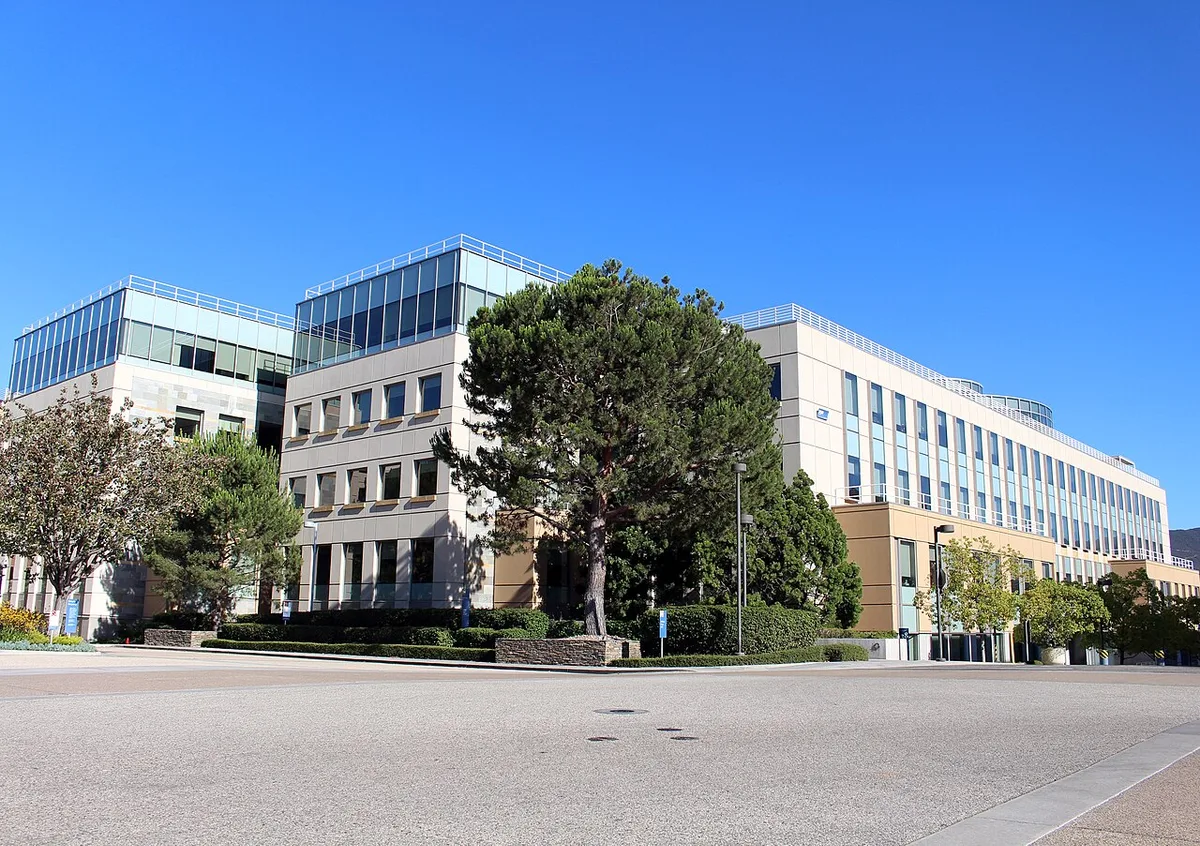



Amgen Inc. is an American multinational biopharmaceutical company headquartered in Thousand Oaks, California. The company is ranked 18th on the list of largest biomedical companies by revenue. The name "AMGen" is a portmanteau of the company's original name, Applied Molecular Genetics.
The company's major products are Prolia and XGEVA (denosumab) to treat osteoporosis and bone diseases ($6.6 billion in total 2025 revenues), Repatha (evolocumab) to treat hyperlipidemia ($3.0 billion in 2025 revenues), Otezla (apremilast) to treat psoriasis and psoriatic arthritis ($2.3 billion in 2025 revenues), Enbrel (etanercept) to treat autoimmune diseases ($2.2 billion in 2025 revenues), Evenity (romosozumab) to treat osteoporosis ($2.1 billion in 2025 revenues), Tepezza (teprotumumab) to treat Graves' ophthalmopathy ($1.9 billion in 2025 revenues), Blincyto (blinatumomab) to treat acute lymphoblastic leukemia ($1.6 billion in 2025 revenues), Nplate (romiplostim) to regulate platelet production ($1.5 billion in 2025 revenues), Tezspire (tezepelumab) to treat asthma ($1.5 billion in 2025 revenues), Kyprolis (carfilzomib) to treat cancer ($1.4 billion in 2025 revenues), Aranesp (darbepoetin alfa) to stimulate erythropoiesis ($1.4 billion in 2025 revenues), Krystexxa (pegloticase) to treat gout ($1.3 billion in 2025 revenues), and Vectibix (panitumumab), a monoclonal antibody ($1.2 billion in 2025 revenues).
Amgen has 17 clinical programs underway in Phase III, eight in Phase II, and 19 in Phase I. Its pipeline includes MariTide, an anti-obesity medication administered once per month by injection.
The company receives approximately 80% of its revenues from sales to the three large U.S. drug wholesalers: McKesson Corporation, Cencora, and Cardinal Health.
The company is ranked 134th on the Fortune 500 and 202nd on the Forbes Global 2000.
In 2020, the company was added to the Dow Jones Industrial Average (DJIA).
Contents
History
In April 1980, Amgen was founded in Thousand Oaks as Applied Molecular Genetics. Amgen was backed by a small group of venture capitalists, and its early focus was on recombinant DNA technology and recombinant human insulin.
Winston Salser, a molecular biologist at UCLA recruited its initial scientific advisory board consisting of Norman Davidson, Leroy Hood, Arnold Berk, John Carbon, Robert Schimke, Arno Motulsky, Marvin H. Caruthers, and Dave Gibson. In October 1980, Amgen named George Rathmann its first president and chief executive officer.
On June 17, 1983, Amgen became a public company via an initial public offering, selling two million common shares and raising nearly $40 million. That same year, after more than two years of work, an Amgen research team led by Fu-Kuen Lin found and cloned the erythropoietin gene, a protein created in the kidney that stimulates red blood cell production. Lin's team created what would become Epogen (epoetin alfa).
In June 1984, Amgen and Kirin Brewery Company formed a joint venture giving Kirin the rights to Epogen in Japan, while Amgen retained United States distribution rights; both companies had the opportunity to expand to other countries. This joint venture gave way in 2017 to a new joint venture, Kirin-Amgen, which bought out Kirin Holdings stake. A year later, Amgen researcher Larry Souza and his team cloned granulocyte colony-stimulating factor (G-CSF), leading to the development of Neupogen (filgrastim).
In October 1988, Gordon Binder was named CEO, succeeding George Rathmann. The following year, in 1989, Amgen received approval for the first recombinant human erythropoetin product, Epogen (epoetin alfa).
In February 1991, Amgen received FDA approval for Neupogen for the prevention of infections in patients whose immune systems are suppressed due to cancer chemotherapy.
Amgen opened a new manufacturing facility in Puerto Rico, in March 1993, which later became the company's flagship manufacturing site.
2000–2014
Binder was succeeded as CEO by Kevin W. Sharer in 2000. Robert A. Bradway became Amgen's president and chief executive officer in May 2012, following Sharer's retirement.
In June 2010, Amgen received approval by the Food and Drug Administration for Prolia, a protein drug for the treatment of post-menopausal osteoporosis. In clinical trials, Prolia reduced the rate of vertebral fractures by 61% and the risk of hip fractures by 40%. In November 2010, the FDA approved Xgeva for the prevention of complications of bone metastases in patients with solid tumors. The clinical trials primarily enrolled patients with breast or prostate cancer.
In March 2011, Amgen acquired a manufacturing facility near Dublin, Ireland.
Amgen opened an affiliate in China in 2013.
In November 2014, the company halted all trials of rilotumumab in advanced gastric cancer patients after one of the trials found more deaths in those who took the compound with chemotherapy, than those without. Also in November 2014, the company, in conjunction with AstraZeneca, reported positive results for brodalumab in a Phase III trial comparing the compound with ustekinumab and a placebo in treating psoriasis. In the same month, construction was completed on Amgen's next-generation biomanufacturing facility in Singapore. Blincyto (blinatumomab) was approved by the FDA in December of that year.
2015–2020
In March 2015, the company announced that it would license its Phase II candidate drug AMG 714 to Celimmune, which will develop the anti-IL-15 monoclonal antibody for treatment against diet nonresponsive celiac disease and refractory celiac disease. In August 2015, Repatha (evolocumab) was approved by the FDA.
In September 2016, the company announced it would purchase the rights to Boehringer Ingelheims Phase I bispecific T-cell engager compound (BI 836909, now AMG 420) for use in the treatment of multiple myeloma. Also in September, the FDA approved Amjevita (adalimumab-atto). The FDA approved Parsabiv in February 2017 and Mvasi (bevacizumab-awwb) in September.
In July 2018, Amgen began constructing a biomanufacturing plant at its campus in West Greenwich, Rhode Island.
In January 2019, Evenity (romosozumab) received approval in Japan, followed by FDA approval in April. In June, Kanjinti (trastuzumab-anns) was approved by the FDA.
In December 2019, the FDA approved Avsola (infliximab-axxq).
In September 2019, FDA granted fast track designation to sotorasib for the treatment of metastatic non-small-cell lung carcinoma (NSCLC) with the KRAS G12C mutation.
In April 2020, Amgen established Amgen K.K. as the company's wholly owned affiliate in Japan. The company announced in July that the United States Court of Appeals for the Federal Circuit had upheld the validity of two Amgen patents that described and claimed Enbrel and methods for making it. The appellate court affirmed an August 2019 decision by the United States District Court for the District of New Jersey and rejected Sandoz's attempt to invalidate the patents on Enbrel.
In August 2020, Amgen, Takeda Pharmaceutical Company, and AbbVie, as part of a COVID-19 research and development (R&D) alliance, announced the first patients enrolled in the I-SPY COVID clinical trial. The trial evaluated the efficacy of Otezla and two other medicines in severely ill, hospitalized COVID-19 patients who required high-flow oxygen.
Corporate affairs
Sponsorships
In December 2023, Amgen became the title sponsor of the Irish Open in golf, renaming it the Amgen Irish Open.
Philanthropy
In October 2017, the Amgen Foundation pledged $3 million to Khan Academy to support the development of free online biology lessons. In July 2020, Amgen granted an additional $3 million Khan Academy to support educational equity and science learning.
In January 2020, the Amgen Foundation and Harvard University debuted LabXchange, a free online science education platform. Amgen and the Amgen Foundation announced a commitment of up to $12.5 million to support COVID-19 relief efforts in March.
In November 2021, Amgen awarded a $2 million grant to the CDC Foundation to launch the latter's EmPOWERED Health Program, promoting patient engagement in decision making for cancer treatments.
Products
Amgen's approved drugs or therapeutic biologicals include:
Aimovig (erenumab-aooe) for migraine headaches (FDA approved May 2018)
Amjevita (adalimumab) (FDA approved September 2016)
Aranesp (darbepoetin alfa) for anemia (FDA approval in September 2001)
Blincyto (blinatumomab for the treatment of acute lymphoblastic leukemia)
Corlanor (ivabradine)
Enbrel (etanercept) for various forms of arthritis
Epogen (erythropoietin) for anemia
Evenity (romosozumab-aqqg) for osteoporosis
Imlygic (talimogene laherparepvec) for local treatment of unresectable cutaneous, subcutaneous, and nodal lesions in melanoma recurrent after initial surgery (FDA approved October 2015)
Kanjinti (trastuzumab-anns) (FDA approved June 2019)
Krystexxa (pegloticase)
Kyprolis (carfilzomib)
Lumakras (sotorasib)
Mvasi (bevacizumab-awwb)
Neulasta (pegfilgrastim) for neutropenia (FDA approved 2002)
Neupogen (granulocyte colony-stimulating factor) for neutropenia
Products developed and then sold
Kepivance (palifermin for oral mucositis, sold to Biovitrium, now Swedish Orphan Biovitrum, in December 2008
StemGen (ancestim) for use in combination with filgrastim for mobilizing peripheral hematopoietic stem cells) (sold to Biovitrium, now Swedish Orphan Biovitrum, in December 2008)
Kineret (anakinra) for rheumatoid arthritis, exclusively licensed to Biovitrium, now Swedish Orphan Biovitrum, in December 2008
Legal issues
In December 2012, Amgen plead guilty and agreed to pay $150 million in criminal penalty and $612 million to resolve 11 related whistleblower complaints regarding the improper marketing of anemia drug Aranesp. According to the United States Department of Justice, Amgen sold the drug for off-label uses at dosages that the FDA had rejected or never approved.
In May 2025, a jury awarded Regeneron $406 million from Amgen, which engaged in anticompetitive practices to increase sales of its cholesterol-reduction drug Repatha at the expense of Regeneron's Praluent.