
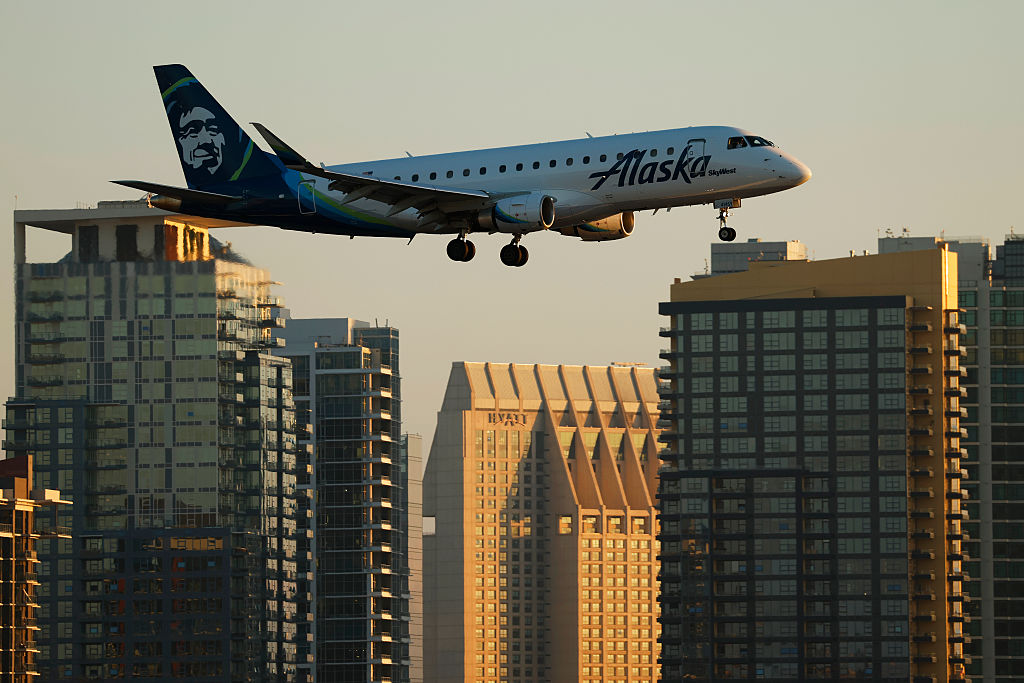
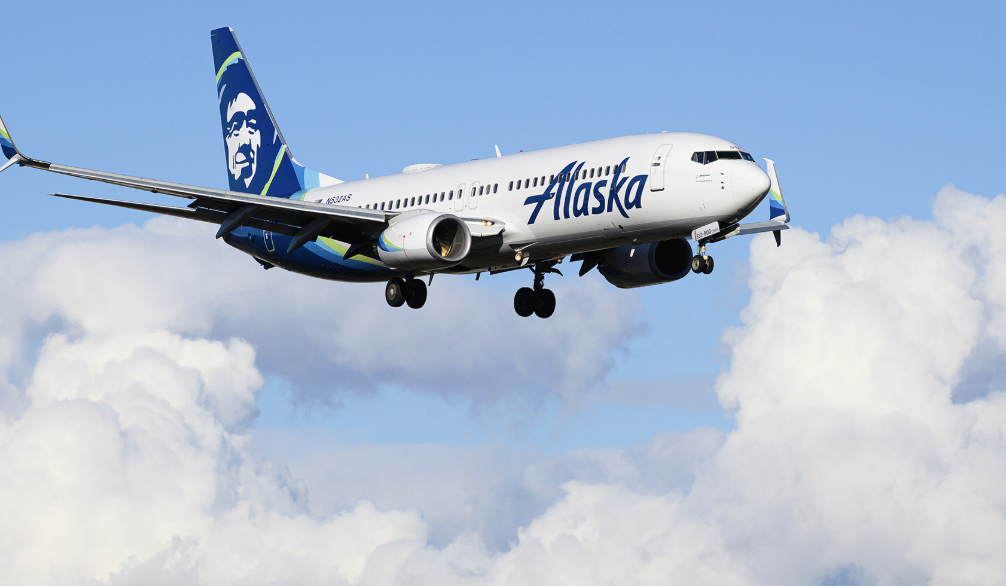

Alaska Airlines is a major airline in the United States headquartered in SeaTac, Washington, within the Seattle metropolitan area. It is the fifth-largest airline in North America when measured by scheduled passengers carried, as of 2024. Alaska, together with its regional partners Horizon Air and SkyWest Airlines, operates a route network primarily focused on connecting cities along the West Coast of the United States (including Alaska and Hawaii) to over 100 destinations in the contiguous United States, North America, Asia, Oceania, and Europe.
The airline operates out of seven hubs with its primary hub at Seattle–Tacoma International Airport. Alaska Airlines is a member of Oneworld, the third-largest airline alliance in the world. As of 2020, the airline employs over 16,000 people and has been ranked by J. D. Power as having the highest customer satisfaction of the traditional airlines for twelve consecutive years. In 2024, the airline's parent Alaska Air Group completed an acquisition of Hawaiian Airlines.
Contents
History
Early years (1932–1945)
McGee Airways, a precursor to Alaska Airlines, was established by Linious "Mac" McGee and flew its first service between Anchorage and Bristol Bay. Service was unscheduled, with flights taking off when passengers, a load of cargo, or mail needed passage.
The airline struggled financially during the Great Depression. Too many airlines were in Anchorage at the time, with not enough demand to support them. As a result, the airline underwent multiple mergers. The first of these mergers was in 1934, when McGee sold his namesake airline for US$50,000 (equivalent to $1,203,358 in 2025) to Star Air Service, an airline also located in Anchorage. This allowed McGee to enter the mining industry. With a fleet of 15 aircraft, Star Air Service was a dominant airline in Alaska, but the airline continued to struggle financially because of high maintenance costs for its wood-and-fabric planes.
In 1937, McGee came back to the airline and opened a liquor store, and the airline began flying liquor to remote Alaskan communities. That year, Star Air Service purchased Alaska Interior Airlines and was incorporated as Star Air Lines. Star was again sold later that year to a group of miners.
In 1938, federal regulation began when Congress created the Civil Aeronautics Board (CAB), which awarded the airline most of the routes that it wanted in Alaska, but the coveted route between Seattle and Fairbanks was awarded to Pan American Airways.
In 1941, Star Air Service was purchased by Raymond Marshall, a businessman from New York City. In 1942, the airline purchased three other airlines in Alaska, including Lavery Air Service, Mirow Air Service, and Pollack Flying Service. They also purchased a hangar at the Anchorage airport. In 1942, the airline's name was changed to Alaska Star Airlines.
When the United States entered World War II in December 1941, Alaska Airlines faced a shortage of pilots. During the war, the airline lacked funds and equipment, and pilots were often forced to buy fuel for their planes out of their own pockets. The company, which was frequently subjected to lawsuits, also went through many different presidents during this time. In 1943, Alaska Airlines purchased the Lockheed Model 18 Lodestar, its first multi-engine aircraft. That same year, the company's stock was traded for the first time on the American Stock Exchange.
Expansion after World War II (1945–1949)
In 1945, Alaska Airlines hired its first stewardesses. In 1947, James Wooten became president of the airline and began an effort to expand the company. Under his leadership, the airline purchased many surplus military aircraft from the government that had been used during World War II. The airline purchased Douglas DC-3s, Douglas DC-4s, and Curtiss-Wright C-46 Commandos. Alaska Airlines was the first carrier certified to operate DC-3s on skis.
Alaska Airlines' large charter business made it profitable, and the airline moved its base of operations to Paine Field, an airport, in Everett, Washington, north of Seattle. It kept a branch office in Anchorage. Despite its success, Alaska Airlines' worldwide charter business was short-lived. In 1949, the CAB tightened its regulations and placed heavy fines on the airline, shutting down the charter service completely for safety violations, and president James Wooten left the company. Also in 1949, Alaska Air began operating five Bell 47B helicopters to support oil exploration on the North Slope thus becoming the first airline in Alaska to operate rotary-wing aircraft.
In 1949, the airline was a major participant in an effort by the newly established state of Israel to airlift Jews out of Yemen to Israel in what became known as Operation Magic Carpet. C-46 or DC-4 aircraft were used for the nearly 3,000-mile flight, made necessary to avoid overflying Arab nations. Planes flew from Eritrea to Aden, then along the Gulf of Aqaba to Tel Aviv. After unloading the refugees, crews then immediately continued to Cyprus, afraid to stay on the ground in Tel Aviv for fear of being bombed. Some 49,000 Yemenite Jews were airlifted by Alaska Airlines and other carriers without a single loss of life.
New leadership (1950s)
Alaska Airlines started the 1950s without its worldwide charter business and operations restricted to the state of Alaska. In 1950, it purchased two smaller Alaskan airlines, Collins Air Service and Al Jones Airways.
Though the airline had grown much under the ownership of Raymond Marshall, the CAB forced him out in 1951 due to continuing financial troubles. Marshall had owned Alaska Airlines with the intent of getting money for himself and he was not concerned about the long-term stability of the company. In 1951, the CAB awarded Alaska Airlines with a temporary certificate allowing them to operate on routes from the Alaskan cities of Anchorage and Fairbanks to Seattle and Portland in the contiguous United States. This award became permanent in 1957.
In 1952, the CAB appointed Nelson David as president, and he began to improve the financial stability of the airline. By 1957, with the carrier in a better financial situation, David left and Charles Willis Jr., became the company's new president and CEO. Willis was a highly decorated naval aviator in World War II, founder of his own cargo airline, Willis Air Service (1945–1949), and a former political operative for President Eisenhower. Willis introduced several marketing gimmicks that set the airline apart from other ones of the day; namely, under his leadership, Alaska Airlines became the first to show inflight movies. The company began service with the Douglas DC-6, the airline's first pressurized plane, enabling flights above clouds and weather disturbances. On these DC-6s, the airline introduced "Golden Nugget" service, which included an on-board saloon and piano.
Jet age (1960s)
In 1961, competitors began introducing jets on routes Alaska Airlines flew. To counter this competition, Willis negotiated with aircraft manufacturer Convair to purchase a Convair 880 jetliner with no money down, for use on routes between Alaska and the contiguous United States. The company introduced the new jet aircraft in 1961. In 1966 the company received its first Boeing 727-100 jets. They removed the Convair 880 from the fleet as a financing condition by Boeing concerning the purchase of the 727 jetliners. Several of Alaska's first 727s were series 100C models, which could be operated as all-cargo freighters, an all-passenger configuration or as mixed passenger/freight combi aircraft.
In the spring of 1967, greatly increased passenger loads required a quick addition of fleet aircraft. Alaska purchased a Convair 990 jetliner, formerly operated by Brazilian air carrier Varig as PP-VJE, which then became Alaska Airlines N987AS. This aircraft remained in service along with an increased fleet of Boeing 727-100s. They were joined by stretched Boeing 727-200s which became Alaska Airlines' signature aircraft for the next 25 years. It became the first carrier to fly the Lockheed L-100 Hercules L382 model, the civil version of the military C-130 cargo turboprop, which was used to transport oil drilling rigs to Alaska's North Slope and later to Ecuador.
Alaska also owned Lockheed Constellation propliners including two Lockheed L-1649A Starliners from 1962 to 1968, and three L-1049's which were used for Military Air Transport Service operations. Smaller prop and turboprop aircraft were operated, including the Convair 240, de Havilland Canada DHC-6 Twin Otter and Super Catalina amphibian aircraft as well as two versions of the Grumman Goose amphibian aircraft, one with piston engines and the other model is a conversion to turboprop engines which the airline called the "Turbo-Goose". The Catalina and Grumman amphibian seaplane aircraft joined the fleet when the airline acquired local southeast Alaska operator Alaska Coastal Airlines in 1968.
During this time, Alaska Air faced some tough competition from other airlines, such as Northwest Airlines, Pan Am, and Pacific Northern Airlines, an Alaska-based air carrier operating Boeing 720 jetliners that was acquired by and merged into Western Airlines in 1967. Northwest and Pan Am at different times operated Boeing 747 wide-body jetliners on their services to Alaska with Northwest flying Seattle–Anchorage nonstop with the jumbo jet and Pan Am flying Seattle–Fairbanks nonstop with the 747. To set itself apart from the competition, Alaska Air turned to some cheap but imaginative gimmicks such as having safety instructions read as rhymes, staging fashion shows in the aisles, and having bingo games on board while en route.
Economic hardship (1970s)
In the beginning of the 1970s, Alaska Airlines began Boeing 707 charter flights to Siberia in the Soviet Union. This was the result of three years of secret negotiations between Alaska Airlines and Soviet authorities, in which the US Department of State reluctantly chose not to block the plan for fear of a potentially negative response from the Soviets. The airline gained permission to fly more than two dozen flights in 1970, 1971, and 1972. Alaska Airlines was also operating Boeing 707, Boeing 720, and Boeing 720B jetliners in scheduled passenger service between destinations in Alaska and Seattle during the early and mid 1970s.
Like much of the airline industry at the time, Alaska Airlines was hit with rising fuel and operating costs and was on the verge of bankruptcy. Additionally, revenues were significantly reduced when work on the Trans-Alaska Pipeline System was delayed. The airline's cargo aircraft had played a key role in building the pipeline, but now sat idle. The airline took another blow on September 4, 1971, when a Boeing 727-100 jetliner crashed on landing in Juneau, killing 111 people and resulting in America's worst single-plane crash at the time. Because the airline was struggling financially, Alaska Airlines' board ousted president and CEO Charles Willis. Former board member Ronald Cosgrave succeeded him.
The airline was US$22 million in debt when Cosgrave took over, resulting in major cuts. The airline's cargo business was dropped completely, as were many flights and employees. Cosgrave also sought to improve the airline's tarnished image of "Elastic Airlines", referring to its poor schedule keeping. The logo was changed to an image of a smiling Inuk man, which remains today. Although the exact identity of the man is unknown, some believe it to be the face of either Chester Seveck, a reindeer herder in Kotzebue, or Oliver Amouak, an Inupiat man. Both were Alaskan natives. As a result of these efforts, the airline made a profit in 1973 and continued to be profitable thereafter.
Post-deregulation expansion (1978–1990)
Alaska Airlines was one of only three US carriers that supported the 1978 Airline Deregulation Act, knowing that it would reap significant growth and other benefits from deregulation. After deregulation, the company's real-estate division was spun off into its own company, with Cosgrave becoming its chairman. The leadership of the airline was passed to Bruce Kennedy, a close associate of Cosgrave. Cosgrave allied with Alaska Airlines to purchase competitor Wien Air Alaska. This ultimately failed and resulted in fines for Alaska Air and its leaders for improprieties during the attempted acquisition. Wien Air was liquidated in 1984, and never merged into Alaska Airlines.
At the time of deregulation, Alaska Airlines served ten cities in Alaska and one in the contiguous US—the city of Seattle—and it had only ten planes in its fleet. Immediately after deregulation, the airline began to expand, adding the cities of Portland and San Francisco to its network. Soon later, the airline resumed services to the Alaskan cities Nome and Kotzebue, and it introduced service to Palm Springs, California. Burbank and Ontario were added in 1981. In 1979, Alaska studied the possibility of acquiring and merging with Hughes Air West, but the plan never went through. By 1985, the airline had also added service to Oakland and San Jose in California, Spokane in Washington, Boise in Idaho, and Phoenix and Tucson in Arizona.
Deregulation also brought challenges to the airline. The airline was faced with increased competition and inflation that put tremendous pressure on costs, profits, and salaries. By 1979, competitors Northwest Airlines and Western Airlines were both flying wide-body McDonnell Douglas DC-10 jets on the core Anchorage–Seattle nonstop route. Additional competition came from Wien Air Alaska, which had begun flying nonstop jet service between Anchorage and Seattle. Northwest was operating nonstop DC-10 service on the Fairbanks–Seattle route at this time as well. There were tensions with unions, particularly mechanics and flight attendants. In 1985, the company had a three-month-long strike with its machinists. By June 1985, it was able to end the strike by promising to reduce labor costs and maintain peace with unions. In November 1985, the airline introduced a daily air-freight service called Gold Streak, with service to and from Alaska.
In the 1980s, Alaska Airlines began acquiring McDonnell Douglas MD-80s to replace its aging 727s. Alaska was the launch customer for the MD-83, taking delivery of its first MD-80s in 1985.
New competition, new technologies (1990s)
The airline began the 1990s with plans to lease 24 Boeing 737-400s from International Lease Finance Corporation (ILFC). The first aircraft was delivered in April 1992.
In 1991, Alaska Airlines added several routes. In the Russian Far East, it added the cities of Magadan and Khabarovsk, as well as service to Toronto, its first Canadian city and the first city east of the Rocky Mountains. Toronto was later dropped in 1992 and the Russian destinations were discontinued in 1998.
As the airline marked its 19th consecutive year of profits in a turbulent industry and racked up many awards for customer service, Bruce Kennedy retired in May 1991 and was succeeded by Raymond J. Vecci.
During this time, Alaska Airlines faced increased competition from low-cost carriers, namely MarkAir. Since it began operating in 1984, competition had been reduced due to feeder agreements with Alaska Airlines. However, after Alaska Air declined to buy the airline in the fall of 1991, competition with Alaska intensified. MarkAir offered low-cost service on the Anchorage-Seattle route and other routes in Alaska, where Alaska Airlines earned almost one-third of its revenues. For the first time in 20 years, it posted a loss of US$121 million.
To save money, the airline canceled two proposed maintenance facilities and deferred a large aircraft purchase worth US$2 billion. Deferred maintenance from this period of cost-cutting would ultimately cause the crash of Flight 261 in 2000, but at the time, this increased the usability of their fleet, and as a result, revenue. The deferred maintenance also cut labor costs, saving the airline money but increasing tensions between the airline and labor unions. The cost reductions produced quick results. In 1993, their losses decreased to US$45 million and they made a US$40 million profit the next year. Eight percent of these revenues were generated by record-setting cargo operations.
Alaska had more competition in 1993 when low-cost airline Southwest Airlines entered the Pacific Northwest by purchasing Morris Air. Alaska Airlines was able to keep its costs down, but it maintained its high level of customer service. The airline promoted itself as "the last great airline" and with the motto "For the same price, you just get more". Analysts felt that Alaska Air needed deeper cost cuts. At the same time, the company had many strikes by the flight attendants' union. Ultimately, Vecci was dismissed in 1995 and replaced with John Kelly, the former Horizon Air CEO. The airline soon expanded West Coast routes to take advantage of an "open skies" agreement between the US and Canada.
Introducing flights across the U.S. (2000s)
In May 2001, the airline took delivery of its first 737-900. In 2001, the airline was granted slot exemptions by the Department of Transportation to operate a nonstop flight from Ronald Reagan Washington National Airport to Seattle, but it was halted after only a week due to the September 11 attacks. The airline resumed service to Reagan Airport on December 4, 2001, to meet the demand.
In January 2002, William Ayer was named CEO of Alaska Airlines. Ayer had been serving as president under Kelly since 1997, having come to Alaska from Horizon two years earlier after spending 13 years with the smaller airline. Ayer took over as chairman and CEO of the Alaska in 2002 upon Kelly's retirement. He led the company through a transformation called Alaska 2010 that was intended to insulate the airline from the traditional boom-bust cycle of the airline industry.
In 2003, Alaska Airlines won the Technology Leadership Award from the magazine Air Transport World for its pioneering of new technologies both in the airport and within the airplane itself.
In 2005, due to the greater efficiency of the Boeing 737 Next Generation and rising costs for maintenance, fuel, and crew training, Alaska Airlines decided to phase out its remaining 26 MD-80s and trained its pilots to fly the newer Boeing 737-800s that were being ordered to replace them. According to the airline, the MD-80 burned 1,100 US gallons (4,200 L) of fuel per hour, while the 737-800 burned just 850 US gallons (3,200 L) per hour. The last MD-80 flights flew in August 2008, with one flight from San Jose to Seattle and another from Sacramento to Seattle. To mark its transition to an all-Boeing fleet, Alaska Airlines unveiled a 737-800 called Spirit of Seattle with Boeing's house colors painted on the fuselage and the airline's Inuit logo painted on the tail fin.
Also in 2005, Alaska Airlines contracted out many of its jobs, including ground crew positions, to Menzies Aviation. In some cases, this resulted in an almost 40% decline in wages. This agreement was found to be a violation of union agreements in 2008 and the new ground crews caused enough damage to aircraft in the first year to make the savings negligible. In addition, Menzies contractors gained a reputation of stealing from checked bags after a few incidents in 2007.
2010s
In March 2010, Alaska Airlines began service from San Jose, California, to Kahului and Kona, Hawaii, and also from Sacramento, California, to Kahului, Hawaii.
In September 2010, Alaska Airlines began service between Seattle and Lambert-St. Louis International Airport.
In 2011, Horizon Air no longer operated as a separate regional airline. Instead, it transitioned to a capacity purchase agreement (CPA) business model, which had by that time become the regional airline industry standard. Under the CPA, Horizon operates and maintains its aircraft, while Alaska Airlines is responsible for scheduling, marketing and pricing all flights. As part of the change to the new business model, the Horizon Air brand was retired and all Horizon planes were repainted with a co-branded "Alaska Horizon" livery.
Alaska Airlines entered into a similar capacity purchase agreement with the nation's largest regional airline, SkyWest Airlines. Starting in May 2011, SkyWest started operating several routes for Alaska under the brand "Alaska SkyWest".
In January 2011, Alaska Airlines placed an order for thirteen Boeing 737-900ERs to be delivered between 2012 and 2014, with two 737-800s also part of the order.
In 2011, Alaska Airlines partnered with Boeing and Fujitsu to be the first to use a new technology called Component Management Optimization to streamline maintenance checks. It allows mechanics to point a handheld device at little RFID tags attached to certain parts of the aircraft, which will display information about when parts were last replaced. This will allow mechanics to perform inspections quicker than conventional methods. The program is scheduled to launch in 2012.
In mid 2011, the airline issued iPads to its pilots to replace 25 pounds of paper flight manuals that pilots were required to carry on flights (Electronic flight bag). Alaska Airlines is the first major airline to use iPads on flights. All pilots had iPads by June 2011. This was the first part of the airline's initiative to do away with the flight bag. The airline is considering using iPads for displaying aeronautical charts.
2020s
Due to the economic effects of the COVID-19 pandemic, Alaska Airlines announced that it would be reducing its number of employees by 30%. By the end of 2020, the firm cut out around 7,000 job positions out of its 23,000 total.
In February 2020, Alaska Airlines announced its intention to join the Oneworld airline alliance. On March 31, 2021, Alaska Airlines officially joined the Oneworld alliance, adding seven new airline partners, including Iberia, Malaysia Airlines, Qatar Airways, Royal Air Maroc, Royal Jordanian, S7 Airlines, and SriLankan Airlines.
In December 2020, Alaska Airlines agreed to buy 23 Boeing 737 MAX 9 jets.
In November 2021, Alaska Airlines launched seasonal service to Belize, making it the fourth foreign country served by the airline.
In August 2022, Alaska Airlines was reported to be an investor in Twelve, a sustainable aviation fuel (SAF) start up and chemical technology company based in Berkeley, California, that aims to make fuel out of carbon dioxide instead of things like organic vegetable oils, which would supposedly be cheaper than existing SAF production. Twelve's E-Jet fuel would have 90% lower emissions than conventional fuel but not require changing existing aircraft. At proper scale, it would be cost competitive with existing fuel and help allow Alaska Airlines to meet emissions goals.
In October 2022, Alaska Airlines announced an agreement with Boeing to purchase 52 additional Boeing 737 MAX aircraft, the airline's largest aircraft order thus far.
In May 2022, Alaska Airlines removed their inflight magazine, Alaska Beyond, and moved to an airline blog due to COVID-19 cleaning procedures.
In January 2023, Alaska Airlines announced that it had officially dropped plastic cups from its inflight food and beverage services, becoming the first U.S. airline to do so. It said that the move is part of plans to replace its top five waste-producing items from onboard services by 2025.
Acquisition of Hawaiian Airlines
In December 2023, Alaska Airlines announced that it would merge with Hawaiian Airlines for $1.9 billion in cash along with an assumption of approximately $900 million in outstanding debt. Airline industry analysts had promoted the merger for years which would create a combined carrier focused on the western United States. The merger would provide Alaska, which is primarily a domestic carrier with narrow-body aircraft, with Hawaiian's wide-body jets, pilots, and international networks.
The merger would retain both Alaska Airlines and Hawaiian Airlines as separate brands; Hawaiian Airlines would also become a Oneworld member. The two airlines intend to operate a combined frequent-flyer program, with Alaska's Mileage Plan likely to replace HawaiianMiles unless the companies opt for an all-new program. The proposed merger was approved by shareholders of Hawaiian Airlines in April 2024, following earlier approval from both Alaska Air Group and Hawaiian Holdings, Inc.
Under President Biden, the U.S. Department of Justice has worked to prevent further consolidation in the airline industry but it was initially unclear whether the department would file suit against the merger, with analysts noting differences between the proposal and prior proposals opposed by the administration. The main area of regulatory concern was that the deal would put about 40% of the traffic between Hawaii and the mainland U.S. in one company's hands. When the deal was announced, company executives expected approval from the Justice Department to take between a year and 18 months. On August 19, 2024, the U.S. Department of Justice completed its regulatory antitrust review of the proposed acquisition and declined to attempt to block the merger in court. The merger next requires the approval of the U.S. Department of Transportation.
At the time, the companies overlapped on 12 nonstop routes which they described as minimal. Alaska Airlines emphasized its experience operating an intra-Alaska network including service to 16 destinations not reachable by road while pledging to maintain a robust interisland schedule in Hawaii to neighbor islands. The Wall Street Journal speculated that consolidation would lead to higher prices for consumers on flights to Hawaii although this was disputed by the companies.
When the merger was announced, Governor Josh Green (HI) promised that he and the attorney general Anne Lopez would monitor the merger "very closely" adding that both "are very high-quality companies, but ultimately, I will be watching to make sure all of our state's needs are met and all of our workers are cared for." As part of its effort to garner local support for the merger, Alaska Airlines made three key promises to Hawaii residents to maintain the Hawaiian airlines brand, keep all front-line union employees, and protect neighbor island flights. In February 2024, Richard Bissen (mayor of Maui County), Rick Blangiardi (mayor of the City and County of Honolulu), Derek Kawakami (mayor of Kauai County), and Mitch Roth (mayor of Hawaiʻi County) published an open letter in the Honolulu Star-Advertiser declaring their support for the merger as "good for Hawaiʻi" and enhancing service to neighbor islands.
Network
Alaska's route system spans more than 115 destinations in the United States, Belize, Canada, Costa Rica, Guatemala, Japan, and Mexico. Some of the locations served in Alaska include Anchorage, Adak, Cordova, Fairbanks, Juneau, Ketchikan, Kodiak, Kotzebue, King Salmon, Nome, Prudhoe Bay, Sitka, and Utqiagvik (formerly Barrow), several of which are inaccessible by road.
The airline began scheduled operations to the Russian Far East in 1991 following the breakup of the Soviet Union, but suspended the service in 1998 following the 1998 Russian financial crisis.
Alaska has historically been one of the largest carriers on the West Coast of the United States, with strong presences in Anchorage, Seattle, Portland, and San Diego, and serving four airports in the Bay Area and four airports in the Los Angeles metropolitan area.
Some cities in Alaska's network with less traffic are served by regional airline partners under a capacity purchase agreement. Under that agreement, the regional airline is paid to operate and maintain aircraft used on flights that are scheduled and marketed by Alaska Airlines. Alaska's airline partners include wholly owned regional subsidiary Horizon Air and carrier SkyWest Airlines.
Alaska Air Group launched its first modern long-haul international route between Seattle and Tokyo/Narita on May 12, 2025. It uses Hawaiian Airlines' widebody Airbus A330-200 as a result of Hawaiian's merger with the Alaska Air Group. It is planned to be followed by a Seattle–Seoul/Incheon route in September of 2025 and ten more routes by 2030.
In the Spring of 2026, Alaska launched its nonstop services to London, Rome, and Keflavik with the latter served by a 737 MAX 8. In the Spring of 2027, Alaska will launch nonstop routes to Athens and Paris.
Joint ventures
Alaska Airlines have established joint ventures with the following airlines:
American Airlines
Codeshare agreements
Alaska Airlines is a member of the Oneworld alliance and has codeshares or mileage partnerships with the following airlines:
Interline agreements
Alaska Airlines has Interline agreements with the following airlines:
Services
Cabin
First Class features priority boarding, complimentary food, as well as alcoholic and non-alcoholic beverages. Seating is wider recliner style seats in a 2-2 configuration on mainline aircraft and a 2-1 configuration on regional jets. All seats in First Class have power outlets.
Premium Class is located behind First Class and features 35 inches (890 mm) of seat pitch, four inches (100 mm) more than in Alaska's Main Cabin. Passengers receive priority boarding and complimentary alcoholic or non-alcoholic beverages. A small snack is included and food can be purchased. Premium Class seating can be purchased during booking or given through complimentary upgrades for elite fliers in Alaska's Atmos Rewards loyalty program. On mainline aircraft, all seats in Premium Class have USB and power outlets.
Main Cabin is Alaska's economy class. Main Cabin passengers receive a complimentary non-alcoholic beverage and a small snack. Food and alcoholic beverages are available for purchase. On mainline aircraft, all Main Cabin seats have USB and power outlets.
In-flight services
In 2006, the airline launched its buy on board meal program, on most flights over 2 ½ hours. As part of the program, the airline offers various "Picnic Packs" for a charge in Premium Class and Main Cabin. Picnic packs feature products from West Coast companies including Beecher's Cheese, Tillamook Cheese, Tim's Cascade potato chips and Alaskan Amber beer.
In February 2012, Alaska Airlines started serving coffee from fellow Seattle company Starbucks on all of its flights. Previously Starbucks coffee was only offered on Horizon Air flights. Horizon Air had offered Starbucks coffee since February 1990 and was the first airline in the world to serve Starbucks coffee onboard its flights. In 2023, Alaska changed to serving coffee from Portland-based Stumptown Coffee Roasters.
In July 2018, Alaska Airlines updated much of the First Class menu inspired by the airlines' West Coast presence. New items served included Oregon's Salt and Straw Caramel Ribbon Ice Cream, brownies from Los Angeles-based Sweet Lady Jane, and pasta from Cucina Fresca, based in Seattle. New features included ordering food before flights to allow for meals ready upon seating.
All Alaska Airlines jets are equipped with an in-flight Wi-Fi and streaming entertainment system. It had been announced that soon internet access service will move to a flat $8 charge per flight, but that change only applies to the satellite WiFi-based aircraft. On the older systems, internet service is still fee-based for all passengers, depending on the length of the flight. Streaming entertainment and electronic messaging services are free.
Alaska launched trials of In-flight Wi-Fi Internet service in 2009. The airline tested both the Row44 satellite-based system, before picking the land-based Gogo Inflight Internet system in February 2010. In October 2010, flights between Anchorage and Fairbanks were the first to receive in-flight internet service. In the following months, the system was expanded to cover all routes, except for Hawaii. Alaska Airlines began switching to a satellite-based system in the third quarter of 2019, which is available on all flights, including flights over the Atlantic and Pacific oceans. As of February 2020, 126 of 241 aircraft have satellite WiFi installed.
In August 2025, Alaska Airlines announced the launch of Starlink WiFi onboard all aircraft by 2027. As of late July 2026, approximately 142 aircraft across the Alaska Airlines and Hawaiian Airlines fleets had Starlink WiFi installed.
Reward programs
Atmos Rewards
The frequent-flyer program of Alaska Airlines and its subsidiary Horizon Air is called Atmos Rewards, formerly known as Mileage Plan. The program's airline partners include members of all three major airline alliances (Oneworld, SkyTeam, and Star Alliance), as well as several unaffiliated carriers. The Atmos Rewards program has no membership fee and allows one-way redemption. Accumulated miles do not expire. The program has elite tiers (Silver, Gold, Platinum, and Titanium) for frequent travelers, who are provided with increased travel benefits.
Club 49
In November 2011, Alaska Airlines began a new program, called Club 49, exclusively for Mileage Plan members who are residents of Alaska. Benefits include free checked bags and email notifications about fare sales and discounts. The program has no joining fee and memberships are valid for a year after joining before they need to be renewed.
Alaska Lounge
The airline operates nine Alaska Lounges. Seattle–Tacoma International Airport, Alaska's largest hub, has three. Portland International Airport has two. Ted Stevens Anchorage International Airport, San Francisco International Airport, New York JFK, and Los Angeles International Airport have one each.
Corporate affairs
Alaska Air Cargo
Alaska Air Cargo has regional operations in parts of the United States. It has the most extensive air cargo operations on the west coast of the U.S., larger than any other passenger airline. Alaska's cargo operations are focused primarily on the northwestern contiguous states and Alaska, between Anchorage and Seattle. South of Alaska, primary cargo includes fresh Alaskan seafood. Cargo carried north from Seattle is primarily U.S. Postal Service mail. The airline carries goods for remote Alaskan communities and personal packages.
Worker relations
Alaska's pilot group is represented by the Air Line Pilots Association, International. Its flight attendants are represented by the Association of Flight Attendants.
Since May 2005 (2005-05), the airline's baggage-handling operations have been outsourced to Menzies Aviation. This was in response to the rejection of a contract between IAM, the union which represented the baggage handlers, and Alaska Airlines. It saved the airline an estimated $13 million a year. In late 2016, Alaska Airlines created a wholly owned subsidiary McGee Air Services, which competed with Menzies Aviation for ground handling contracts in select Alaska cities.
Accidents and incidents
Alaska Airlines has had 12 major aviation accidents in its history, nine of which resulted in deaths, with the other three resulting in the aircraft being written off but no deaths. A total of 226 passengers and crew along with two people on the ground have been killed.
On November 30, 1947, Flight 009, a Douglas C-54A (NC91009), with routing Anchorage–Yakutat–Port Hardy–Seattle, crash-landed while attempting to make an Instrument Landing System (ILS) approach at Seattle–Tacoma International Airport in Seattle. The plane went off the runway, rolled down an embankment, struck a ditch, and continued into the intersection of the Des Moines Highway and South 188th Street where it struck an automobile, caught fire and spilled fuel over the area. Of the 28 occupants, eight died, plus the driver of the car. The crash was attributed to pilot error.
On January 20, 1949, Flight 8, a Douglas C-47A (NC91006), was on routing Homer–Kenai, when the plane struck the side of Ptarmigan Head 9 miles (14 km) east of the center of the airway to Kenai. Of the six occupants on board, five died. The cause was determined to be the pilot straying off the designated airway.
On January 26, 1949, an Alaska Airlines Curtiss C-46 (N1241N) crashed at Asmara, then in the Ethiopian Empire (now in Eritrea), attempting to return to the field after losing an engine on takeoff. The aircraft was a write off, but there were only minor injuries among the four crew.
On August 8, 1954, an Alaska Airlines C-47A (N91008) operating the routing of McGrath, Alaska to Colorado Creek, Alaska, crashed into the side of a mountain about 25 miles (40 km) northwest of McGrath. Both pilots died.
On March 2, 1957, Flight 100, a Douglas C-54B (N90449) on the routing of Seattle–Fairbanks–Seattle hit a mountain 3.8 miles (6.1 km) from Blyn while on approach to Seattle. All five occupants died. The cause of the crash was the pilot's decision to enter an area of low overcast in mountainous terrain, as well as a navigation error.
On July 21, 1961, Flight 779, a Douglas DC-6A (N6118C) operating Seattle-–Shemya crashed short of the runway, killing the six crew. The cause of the crash was that the power to the runway and approach lighting systems had been cut off two days earlier, and the control tower neglected to inform the pilots this as they made their approach in the dark.
Employee incidents
On September 2, 2019, an Alaska Airlines flight attendant called for an evacuation of Terminal A of the Newark Liberty International Airport, causing panic among Labor Day travelers. The flight attendant was subsequently detained by police who determined that the incident was a false alarm; the employee reportedly suffered from a mental health-related issue at the time.
On October 22, 2023, an Alaska Airlines off-duty pilot, Joseph Emerson, reportedly attempted to shut down the engines of Alaska Airlines Flight 2059 operated by Horizon Air before being subdued by crew members. The aircraft made an emergency landing at Portland International Airport and landed safely. The off-duty pilot was charged with 83 counts of attempted murder. Passengers from the flight initiated a class action lawsuit against Alaska Airlines and Horizon Air, alleging emotional distress from the incident. The plaintiffs sought a thorough explanation and improved pre-flight screenings to prevent similar occurrences, emphasizing the need for vigilance regarding airline staff's mental health. Alaska Airlines recognized the lawsuit and commended the crew for their actions during the emergency.