Filming
As the science writer Ron Miller notes, A Trip to the Moon was one of the most complex films that Méliès had made, and employed "every trick he had learned or invented". It was his longest film yet; both the budget and filming duration were unusually lavish, costing ₣10,000 to make and taking three months to complete. The camera operators were Théophile Michault and Lucien Tainguy, who worked on a daily basis with Méliès as salaried employees for the Star Film Company. In addition to their work as cameramen, Méliès's operators also did odd jobs for the company such as developing film and helping to set up scenery, and another salaried operator, François Lallement, appeared onscreen as the marine officer. By contrast, Méliès hired his actors on a film-by-film basis, drawing from talented individuals in the Parisian theatrical world, with which he had many connections. They were paid one Louis d'or per day, a considerably higher salary than that offered by competitors, and had a full free meal at noon with Méliès.
Méliès's film studio, which he had built in Montreuil, Seine-Saint-Denis in 1897, was a greenhouse-like building with glass walls and a glass ceiling to let in as much sunlight as possible, a concept used by most still photography studios from the 1860s onward; it was built with the same dimensions as Méliès's own Théâtre Robert-Houdin (13.5 × 6.6 m). Throughout his film career, Méliès worked on a strict schedule of planning films in the morning, filming scenes during the brightest hours of the day, tending to the film laboratory and the Théâtre Robert-Houdin in the late afternoon, and attending performances at Parisian theatres in the evening.
According to Méliès's recollections, much of the unusual cost of A Trip to the Moon was due to the mechanically operated scenery and the Selenite costumes in particular, which were made for the film using cardboard and canvas. Méliès himself sculpted prototypes for the heads, feet, and kneecap pieces in terracotta, and then created plaster moulds for them. A mask-making specialist, probably from the major Parisian mask- and box-making firm of the Maison Hallé, used these moulds to produce cardboard versions for the actors to wear. Though other details about the film's making are scarce, the film historian Georges Sadoul argued that Méliès most likely collaborated with the painter Claudel on the scenery, and with Jehanne d'Alcy on the costumes. One of the backdrops for the film, showing the inside of the glass-roofed workshop in which the space capsule is built, was painted to look like the actual glass-roofed studio in which the film was made.
Many of the special effects in A Trip to the Moon, as in numerous other Méliès films, were created using the substitution splice technique, in which the camera operator stopped filming long enough for something onscreen to be altered, added, or taken away. Méliès carefully spliced the resulting shots together to create apparently magical effects, such as the transformation of the astronomers' telescopes into stools or the disappearance of the exploding Selenites in puffs of smoke. Other effects were created using theatrical means, such as stage machinery and pyrotechnics. The film also features transitional dissolves.
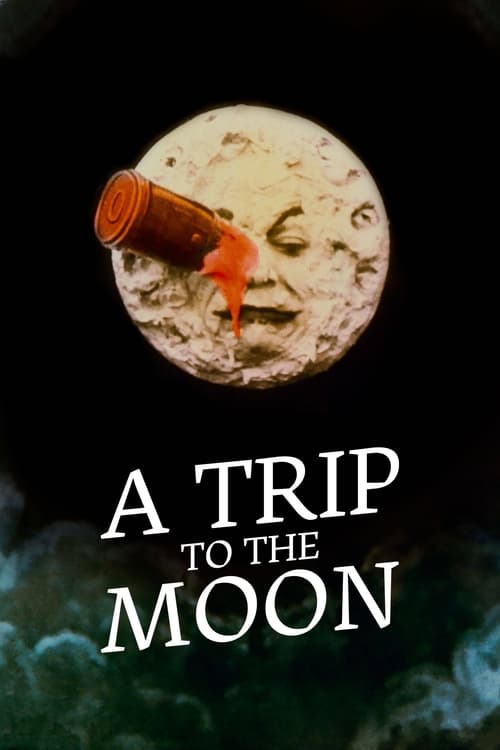
The pseudo-tracking shot in which the camera appears to approach the Man in the Moon was accomplished using an effect Méliès had invented the previous year for the film The Man with the Rubber Head. Rather than attempting to move his weighty camera toward an actor, he set a pulley-operated chair upon a rail-fitted ramp, placed the actor (covered up to the neck in black velvet) on the chair, and pulled him toward the camera. In addition to its technical practicality, this technique also allowed Méliès to control the placement of the face within the frame to a much greater degree of specificity than moving his camera allowed. A substitution splice allowed a model capsule to suddenly appear in the eye of the actor playing the Moon, completing the shot. Another notable sequence in the film, the plunge of the capsule into real ocean waves filmed on location, was created through multiple exposure, with a shot of the capsule falling in front of a black background superimposed upon the footage of the ocean. The shot is followed by an underwater glimpse of the capsule floating back to the surface, created by combining a moving cardboard cutout of the capsule with an aquarium containing tadpoles and air jets. The descent of the capsule from the Moon was covered in four shots, taking up about twenty seconds of film time.
.png?width=400)